Akron, Ohio, is a wonderful example of a mid-sized, mid-American city.
According to
Wikipedia, Akron was founded nearly 200 years ago. The current American school system of “K-12” grades funded by property taxes was created in Akron in the 1840s, and the roots of Quaker Oats were sown in the 1860s when Ferdinand Schumacher’s mills along the Ohio Canal were used to grind oats for cereal bars to feed the Union troops.
At the turn of the 20th century, Akron became Rubber Capital of the World, when Goodyear Tire and Rubber Corporation, along with related companies like Firestone and Goodrich, built headquarters there. Goodyear and its iconic blimp are still present, along with a legacy of old factories, streets named for the founders, and hundreds of acres of parks preserved by their donations. As perhaps Akron’s greatest contribution to society, the Rubber Duck was created there, hence why their minor league baseball team is called the “
Akron RubberDucks”.
Currently, the area is undergoing a revival. New buildings are going up, old warehouses are being renovated for new uses, and it has become a relative hotbed for new technology companies, as evidenced by Silicon Valley-style ads on the sides of buses for Slack and ad serving technology. Also, LeBron James. And, Steph Curry! And, The Black Keys!!
While all that is testament to Akron being a fine place, it was not on our radar until very recently, when reports came across the Internet that a
Kelp Gull had been found there. Typically, one would find Kelp Gulls in the Southern Hemisphere, being relatively common south of the Tropic of Capricorn from South America and New Zealand, so this was a very notable sighting. North America has been host to fewer than a dozen Kelpies in recorded history, so when we heard about it, we felt obligated to honor this particular gull’s aberrant sense of direction with a visit.
Our flight from SF to Akron via Charlotte was uneventful, if you discount a 3-hour delay in SF at least partly due to a flight attendant calling in sick, which caused us to miss our connecting flight, which resulted in being on standby for the last flight to Akron of the evening, but of course the American agent that rebooked us didn’t actually check us in for that flight, so after every other standby had been called the gate agent asked us why we were still standing there because she had no record of us, and then told us to just go find two empty seats and sit in them. So, we said Hello to Akron at around midnight local time.
Unfortunately for us, this gull was located in a flock of around 1,500-2,000 other gulls. Pulling our needle out of that gull-stack would normally be painful enough, but the flock was found on a lake where they roost at night, so they are viewable only at dawn and dusk; during the day, they disperse to haunt garbage dumps and parking lots.
That is a long explanation for why, with only about 5 hours of sleep, we were standing in the dawn’s early light by the side of a lake on a misty Ohio Wednesday morning, scope and camera at the ready, with five other birders.
However, after an hour of scanning and re-scanning each and every gull for one with a dark back and white head, we all failed to find it. This meant we earned the right to repeat the activity eight hours later as the sun started to set. And at dusk, although bolstered by a nap and a very fine grilled cheese sandwich, we again failed.
Thursday morning began with promise, with mostly clear skies and the temperature bottoming out at an unseasonable, practically balmy, 55F (about 30 degrees above their December average!). The crowd was larger, so with 10 pairs of eyes on the lake, we were sure to find it. And yet, not so much.
We were back again at 4pm, after a day trip to see Cleveland (which appeared to be a very nice, clean city), Lake Erie (where I confirmed that one cannot see the other side even with a scope, you’re welcome), and several thousand more gulls (but not the Iceland Gull that we still need). Our results matched the success of previous attempts.
So, Christmas morning was our last shot, as we had a flight booked at noon for Arizona. Again, the alarm rang out at 630am Eastern. Again, one cup each of lucky coffee was poured for the road. Again, we arrived just as the light was sufficient to make out the shapes of trees and houses, along with four others. And again, the weather was crazy good for December in the Rust Belt.
When the sun was just high enough that we could make out the colors of the gulls, we took turns scanning the flock, as one by one, they began to take flight for their day’s adventures. On my second pass, I talked to myself as I inspected each bird: “Light gull…light gull…light gull…dark…wha?” I called for The Wife to check, as she is not only the Birding Expert of our team, but her eye for color is better.
“Hmm,” she said, “The back is dark enough, but isn’t its head a little too gray?”
Deflated, I return to scanning.
But not thirty seconds later, a cry went up from one of the other scopes: “I think I have it!”
Everyone scrambled to their scope to take a look. It was pointed at my bird.
Thus located, everybody focused their own scope on the target, to triple-check the field marks. She hadn’t been seen for five days, and given the rare nature, potential life bird for all of us, and distance people had (and would) traveled to see it, we all wanted to be completely sure of the identification.
As the light improved slightly, we could see her head was very white, but for a little smudge of eyeliner she was wearing. Her back was a deep solid black, and wingtips were also nearly solid black. We confirmed her size to be just a little smaller that the Herring Gull that drifted by, and got a good view of the dark black pattern on the underside of her wing when she stretched. #689 was confirmed!
(By the way, here’s a shout-out to Matt, a local birder who was with us this morning! Thanks, Matt, for helping us ID the gull, and also for convincing us not to drive to the other side of the lake for a better view!)
Triumphantly, and with only a brief discussion about my potentially wavering faith in The Wife’s eyesight, we returned to the hotel for breakfast.
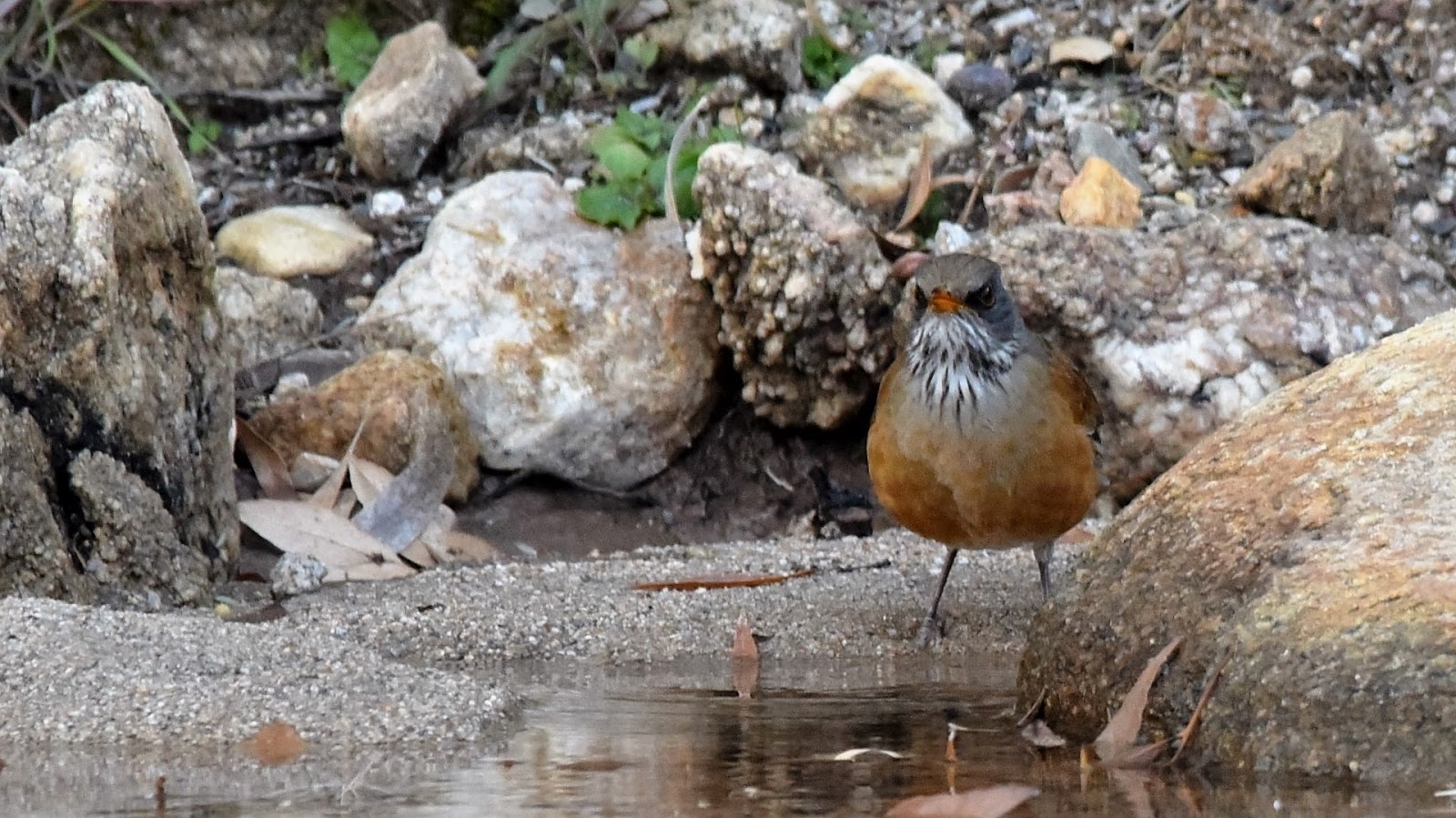
After Christmas morning in Akron, we are now spending Christmas evening in Tucson. Tomorrow we will take another run at the Rufous-backed Robin and hope that this year’s odd weather will encourage some other unusual bird to show up.
Here’s hoping I don’t trip on a cactus this time,
Me
p.s. Hey, Mr. Short-eared Owl, I still haven’t forgotten about you…