Showing posts with label Arizona. Show all posts

Monday, December 28, 2015

You Da Man in Yuma

How do you like the new tourist slogan I've created for Yuma? Hey Yuma, this one is free, but the next one will cost ya! You're welcome!

Yesterday's excursion to Yuma did not yield merely yawns. We yearned for a new bird for the year, and we were not disappointed!

Just before noon, we drove into Riverside Park, located on the Colorado River just a mile or so away from California, and at the base of the Yuma Territorial Prison State Historic Park, where the 3:10 to Yuma stopped. 

Previous reports said that a Streak-backed Oriole, a rare visitor from Mexico, had recently been reported in the palm trees right in front of the parking lot. Given that the last time we tried to find one of these, we flew into Lubbock and drove for five hours, having the opportunity to find one a mere three hours away with no extra plane flights was an offer we couldn't pass up.

As with the Robin the other day, multiple reports had been filed saying that the bird tended to show up during the noon hour. So, with calm, sunny weather beckoning him to return to his favorite tree, The Wife arrayed herself upon the hood of our black car to soak up as much heat as possible as we awaited his return.

12:15 passed, and then 12:30, and we were starting to get nervous. A couple other groups of birders who had been looking since earlier in the morning gave up and departed. In an attempt at reverse psychology, The Wife began to chat with the remaining birders about other failed attempts to locate this kind of oriole, while I pulled up Yelp on my phone to find a good place nearby for lunch.

But at 12:45, a yell went up from the other side of the palms! Somebody had seen a yellow bird fly in! Everybody scrambled from their positions for a look, and sure enough, there he was!


We watched him for nearly 30 minutes before he decided that he'd had enough palm berries, and then flew off toward the river. Yay!

Today, we're taking a day off in Scottsdale, since there's nothing else for us to find in Arizona, and American wants $400 to move our flight by a day. Tomorrow we fly home, and then take one more shot at the nefarious Short-eared Owl.

Only four days to go!

Saturday, December 26, 2015

Sweeping Up, Again

A mere three weeks ago, we stood at the main trailhead in Catalina State Park, just outside of Tucson, hoping to locate a Rufous-backed Robin. Since that time, we have flown across the country (and back!) twice, stood in the rain waiting for a stupid owl multiple times, and explored the wilds of Northern Ohio.

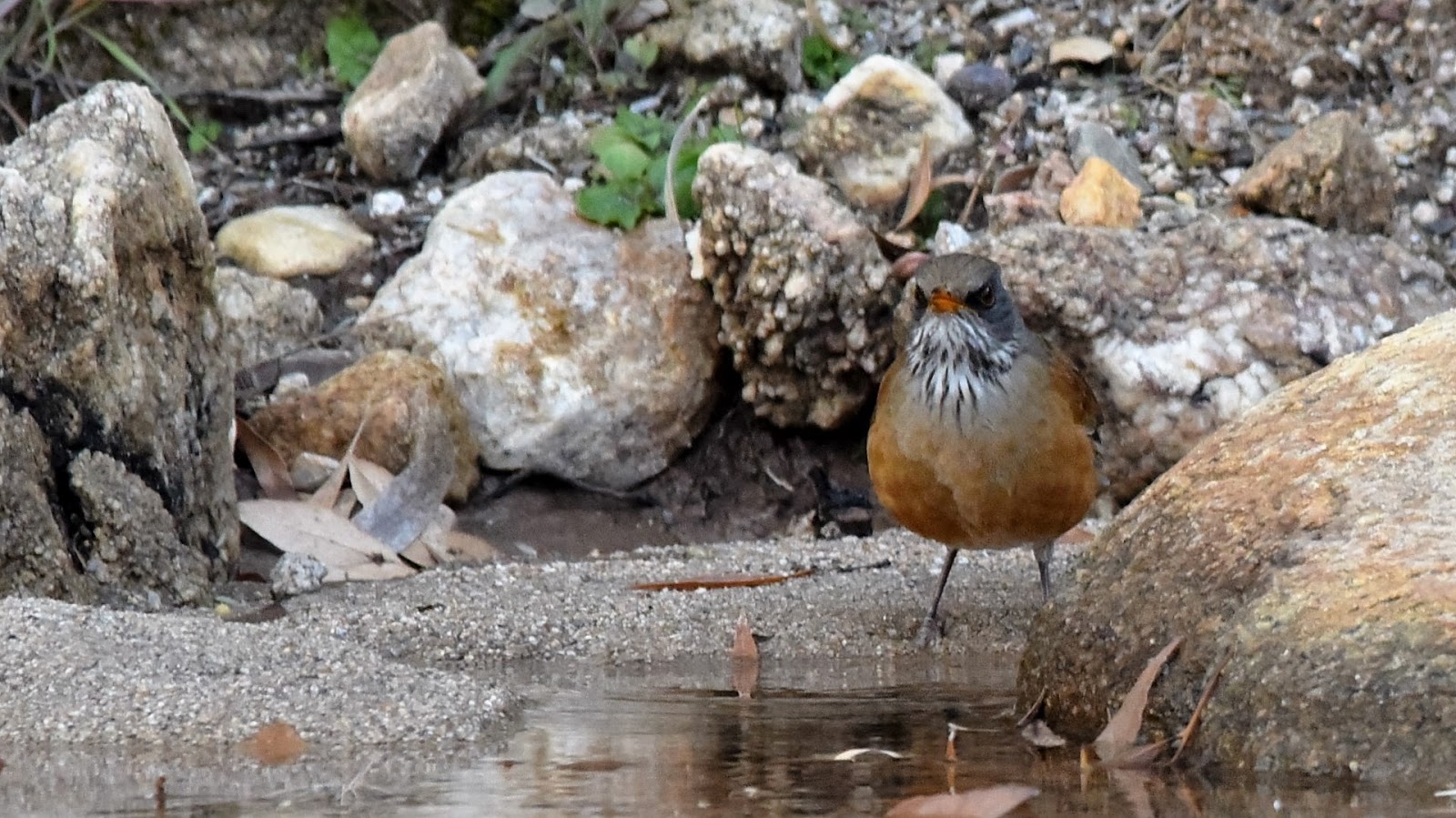
Stopping in Arizona on our way back from Ohio, we decided to give the Robin one more shot. I mean, he seems a reasonable sort of bird--not too elusive, not too easy to find--and he's kind of cute, so why not?

So, while most of our fellow humans enjoyed the ritual that is Boxing Day, we were back at Catalina this chilly morning.

The robin had been reported several times just beyond the start of the trailhead, where the trail crosses a creekbed. Most of the year, this creekbed is completely dry, and in the monsoon season, it can be 50' of raging floodwaters. Right now, however, two narrow streams, each maybe 3-4' wide and and 6" deep in the middle, braid their way downhill.

This causes hikers a bit of a dilemma: do they get wet feet by wading through, or attempt to balance on a few branches others have placed as make-shift bridges? And, what if they have a dog? Does Dobby the Miniature Poodle (a real dog we met today) get his fur dampened, or does he get the royal treatment of being carried across?

A nearly constant stream of hikers set out this morning while we waited for the bird to appear, and we amused ourselves by watching their unique ways of tackling the crossing. For instance, while Mom tried to carry Dobby while precariously and slowly making her way across the branches, her teen-aged Daughter who had already crossed came back to help saying, "Mom, let me take Dobby, because this is painful to watch!"

The prize for Best Crossing went to a man with a small-medium sized dog, maybe 20 pounds in weight. The dog ran up to the edge of the first creek and waited. His owner caught up, picked up the dog, and tossed him across the creek to the other side. The dog then ran up to the second creek, waited, and the routine was repeated. That's ingenuity! (Animal Cruelty Police: Note that it was only a few feet across, and the dog appeared to think it was great fun!)

When the robin hadn't appeared by lunch, we took a break for some tacos and horchata, and studied the recent reports. Twice the bird had been seen in the afternoon at around 2-2:15pm, so we were hopeful that maybe he would swing through the area later.

We returned to the park and set up watch at the appropriate location, and sure enough, at about 2:18pm, we caught a flash of something deep in the brush. It was about the right size, in about the right place, and there he was!


The consistency with which many birds keep their routines never ceases to amaze me!

A mere five days remain this year, and we are continuing to push our total as high as we can go. We have two more days here in Arizona, so our plan for tomorrow is to chase after an unusual oriole that was reported in Yuma. It looks like Yuma will go on the, "Never Thought I'd Go There Once, and Now I Will Go There Twice" list!


Friday, December 4, 2015

Sweeping Up

The broom has been stashed in the closet, and the dustbin has been emptied: The Big Sweep 2015 is done.

We arrived home at about 1AM on Thursday, after leaving Tucson around 9AM on Wednesday. Yes, we drove straight through, about 900 miles, in one LONG-ASS day.

Why would we subject ourselves to this? Well, (A) it's not a Big Year if you don't do crazy stuff, and (B) a bird.

After landing in Tucson on about 1:30p Tuesday, we huddled over a late lunch to make our final plans. Should we put in a few hours driving to make the next day's return tolerable, or take one more shot at the Rufous-backed Robin that eluded us before our flight out? Was that even a question?

So, we drove up to Catalina State Park, a nicely preserved slice of the Sonoran desert that used to be in a rural area, but is now surrounded by apartments and shopping malls (if there's anything that Arizona does well, it's Urban Sprawl). This park has a nice campground, and also happens to be where a robin was reported just after Thanksgiving. We would spend the night there, check the place where it had been reported at dusk and then again at dawn, and then marathon home.

The robin had only been reported once, so we knew our odds were slim. But, you can't win if you don't enter, right?

Hikers, joggers, and dog walkers kept the trails fairly busy, which was good for their aerobic capacity and cholesterol levels, but bad for robins. Trying to think like a bird, we quietly wandered up the desert wash where it had been reported, away from the traffic, listening intently for any calls or rustling that might reveal its presence.

And then, rustling! On the bank of the wash, some tall grasses were swaying, but by the way they moved, we could tell the cause of the activity was much bigger than a robin. Pausing, we waited to see if the creature would reveal itself.

Sure enough:


A Hog-nosed Skunk! And he was so cute, snuffling around in the leaf litter. Wanting a better picture, I moved upstream, giving him a wide berth as he wandered out into the open to get a drink from the stream.

But then he started snuffling his way toward me. And his tail moved from horizontal to vertical. Which doesn't seem like a good thing.


Deciding that I didn't need a close-up picture that badly, and that The Wife wasn't going to appreciate 15 hours in the car with a snunky husband, I hastily retreated. Very hastily. The skunk found my actions satisfactory, moseying back into the deep grass with his tail back at ground-level.

Hog-nosed Skunk, on the prowl


After that encounter, we did find many birds, just not the one we wanted. Several types of sparrows, Abert's Towhees, and other typical desert birds flew and hopped around, taking advantage of the gentle stream for drinks and baths. We were surprised by little flock of Lawrence's Goldfinches that flew in to check out the action:

Lawrence's Goldfinch, named for George Lawrence, a 19th century ornithologist who was a member of a precursor to the Rat Pack. Along with Spencer Baird and John Cassin, he formed a group known as "The Starlings." Their gossip-worthy exploits tore up both the scientific and socialite worlds for several wild years in the mid-1800s, before an unfortunate event in a Paris club involving a bet, two Can-Can dancers, and multiple bottles of absinthe led to their eventual dissolution.

Hanging with the ladies.

Gray Flycatcher


But, no Robin that evening, or the next morning, so we hooked up our trailer, cranked the tunes, and made the journey home.

The entire trip was long and exhausting, but successful and fun. We added a total of 13 new birds for the year, bringing us up to 687. The most we realistically could have added was around 16-18, so we're very happy with this.

What's next? Well, there are only about 10 birds IN ALL OF NORTH AMERICA that have been seen in the past two weeks that we don't yet have. We're going to watch the weather and try to pick up a few more this month. Stay tuned!

Wednesday, November 18, 2015

The Waiting Game, Part 2

Stupid robin.

We never did find that bird, despite spending hours hanging out and waiting, although we did convince the entire neighborhood we are insane, stalkers, or both. And did you know, you can purchase a nice 3 bed, 2 bath house in Ajo, AZ on a 1/3 acre lot for less than $100,000? Or that Ajo is the home to Arizona's first copper mine? These are the things one investigates when one is bored out of one's mind.

Our next destination was the San Rafael Grasslands in Southern Arizona, a beautiful valley of gently rolling hills located about 50 miles southeast of Tucson (although given the road layout, driving there from Tucson takes nearly two hours). Our goal is to find exactly two target birds at this place: Baird's Sparrow, a secretive little pest that we spent hours trying to find in North Dakota, and Short-eared Owl, which isn't secretive but is somewhat scarce and elusive.

We arrived late last night at a relatively nearby campground, Patagonia Lake State Park, which happens to be one of our favorite parks in Arizona for its scenery and proximity to birdy locations. This morning, the alarm went off around 5am local time, and after blearily making coffee, we headed for the hills.

A tip from the local birding email list suggested we start looking for the bird just after entering the grasslands. So, we pulled over about 100 yards past the intersection, and played our recording of a Baird's Sparrow.

After, oh, maybe five seconds, sparrow jumps out of the grass and flies to a nearby bush to give the invader a piece of his mind. A quick glance through the binos showed this:

Check! And this moment goes down in history as the fastest we've ever found a target bird.

But, now, we need an owl. They're usually only seen around dawn and dusk, and we didn't find one during the two hours we drove around the valley. Although we did see five cowboys rounding up their cattle into a pen. Grass-fed beef, anyone?

So, now it's mid-afternoon, and we're waiting. Again.

We'll try for the owl one more time tonight, and then on to Florida tomorrow.

For some reason, I think I want a hamburger for dinner,
Me

Tuesday, November 17, 2015

The Big Sweep

Bienvenidos!

The time is 2:40pm on Tuesday. A Fall chill is in the air, although the sun is shining brightly with not a cloud to be seen. Three young boys are playing basketball in the city park adjacent to which our truck and trailer are parked. We are in Ajo, Arizona. Waiting.

Why we came here will be clear in short order. How we came to be here sounds crazy but is simple enough: we have embarked upon our last major trip of the year, in which we have driven from Napa to southern Arizona, from which we will fly to Florida, then New England, then back to Arizona, for the return drive to Napa. This smells like Madness! And yet, with the gentle aroma of Logic about it.

You see, our route is surgically targeted at areas that still contain birds we need, with the objective of quickly locating those birds and moving on. A Birding Blitzkrieg, if you will.

The first two days of this adventure have involved about 500 miles of driving per day, surrounding a few brief but successful interludes of Bird Finding. And this isn't your typical "take a stroll through a verdant forest and see what you see" birding. No, this is hardcore: go to where you know a bird is at, find it and move on. Muy rápido!

Our first stop was Mercey Hot Springs, a resort in the edge of the Panoche Valley, about 60 miles west of Fresno. We visited this rustic, remote resort not for its famous pools, but for its owls:

"Hey, buddy. You got any mice? No? Then get outta here, or I'll talon you. In the eye."

"Are you looking at ME? Are YOU looking at me? Are you LOOKING at me? Whatever."

For some reason, a large parliament of Long-Eared Owls finds the tamarisk trees at this particular resort to be delightful winter roosts, and they've been returning here for years. Maybe the owls fancy a restorative dip in the bubbling waters at night?

Next stop, another regional attraction that a certain bird finds irresistible: the Calico Ghost Town, outside Barstow. This place is an old silver-mining town that was founded in the 1860s and eventually abandoned when the miners looked at each other and said, "Barstow? We're in Barstow??? Guys, what are we doing? Vegas is just up the freeway! Let's gooooo!"

The arid, rocky hills of this Ghost-Town-slash-County-Park-slash-Tourist-Trap are adored by a large group of Chukars, a quail-like game bird that is native to Asia and was introduced into North America (like the Snowcock and Gray Partridge) because hunters needed more things to shoot. While most birders look for Chukars in picturesque locales like the Sierra foothills, we knew these birds were resident in the area... and not just in the area, in the freaking parking lot:

Chukars, conveniently located between the dumpster and the old lookout tower. 
"Paparazzi! Run! Run!"
Check! So, to the next bird, wiki wiki. Before we arrived, however, we passed through Quartzsite, AZ, a dusty area off I-10 that is one of the Great Wonders of the World. As in, "I Greatly Wonder why the hell so many people come here in the winter when they could be *Anywhere Else*?" The answer, apparently, is cheap camping + rocks. Seriously, people? Rocks? Sigh. Onward!

Last December, had you given me the opportunity to list 100 places we would visit this year, this destination would not have made the list. But, for a bird? We would absolutely drive to the US Army's Yuma Proving Ground for one of them.

Fortunately, they were not testing missiles or shells or whatever else is meant by the sign, "Ordinance deliveries use gate 1B". Unfortunately, we did not see any cool new vehicle prototypes being tested. Fortunately, the Mud Course gates were locked, or I just may have tried driving the F-250 through it. While towing, natch.

But, after driving past the twin artillery guns at the entrance, and then the parking lot of tanks at the visitor's center (Welcome!), we arrived at a golf course just west of the military facility. A Ruddy Ground-Dove, an unusual visitor from Mexico, had been reported in the parking lot, brazenly consorting with Inca Doves. And sure enough:

The Astute Birder will note the lack of scaling, short tail, and white edges on greater coverts of the bird to the far right. The Less Astute will weep.
And thus sprach Zarathrustra: ONWARD!

So, why we came to Ajo on this particular day is, as you guessed, a matter of a birdy importance. Our target? A Rufous-backed Robin, another unusual Mexican visitor. Just one of the three that had been reported here would be sufficient. And according to eBird, everybody who has come within 100 miles of Ajo has seen one.

Us? Not so much.

We arrived here a little past 10AM, and spent two hours walking the neighborhood, trying to scare one up. Every local knows the bird is here, because they've seen the crazy birders wandering about, and we have been asked several times if we had seen it yet ("If I had, would I still be here?" I wanted to reply, snarkily. But, thanks to the elbow of The Wife, I didn't.) Retreating to our trailer for lunch, we were interrupted by a couple of very nice retired ladies who knocked on our door, thinking they may have the bird in their back yard...but alas, it was a Cardinal.

Our current hope is that it will swing by later in the afternoon, maybe once the bars close for siesta.

And, so, we wait. And blog.

Patiently,
Me.

p.s. This is post #100 for the year! If you've read all 100, then you are My Best Friend! If you skipped a few, then no hard feelings... but go back and read them all if you want a Christmas Card. And click on an ad to truly redeem yourself.

Monday, September 21, 2015

On the Kindness of Strangers

¡Hola, desconocidos!

First, an announcement: as of yesterday, this blog has served over 10,000 views for the year! Yay! Feel free to tell your friends about the wonder and glory that is Birds See'd! Post to Facebook and (most appropriately) tweet about it, and otherwise spread the word!

Right now, I'm sitting in a hotel in Tucson, our day of birding here rained out due to severe downpours, thunderstorms, and flash flood warnings. When all Hell is about to break loose meteorologically, one of the last places you want to be is high in the mountains!

That said, while the past couple days have been a bit stormy and unsettled, they have also been great for our bird count and for our general faith in humanity.

The friendliness of birders is something to which we have become accustomed. Compadres in the field are very willing to share information, advice, and even spritz of sunscreen or bug repellent. Such behavior is no longer surprising, and we do our best to reciprocate. When people go beyond this, however, it makes for an amazing and memorable time.

This story starts Saturday morning. We had finally tracked down the Sinaloa Wren after at least four attempts, with key assistance from another group of birders who showed us where his nests were and helped confirm that the brief bit of song we heard was really him. About 30 minutes south, we hiked up Hunter Canyon for our second attempt to find the elusive Slate-throated Redstart, when another birder stopped to point out where we should look.

To pass the dreadfully slow time, I made a reservation through Expedia at a B&B in Patagonia, AZ, where a Plain-capped Starthroat hummingbird had been reported recently. After a couple hours of waiting, the skies darkened to an ugly purple and distant sheets of rain obscured the mountains, and we gave up on the bird and headed to Patagonia.

When we attempted to check in, we found that the B&B didn't actually have any rooms available, but Expedia had booked one anyway and then didn't alert them that we were coming. Instead of just apologizing, they called other places in town, found us a room, and convinced the owner to waive his typical 2-night minimum stay. They even offered to buy us breakfast, since the place they found didn't offer meals! Thank you, Duquesne House!

Arriving at Casitas Frontera, we chatted with the owner about why we were in town. He knew the guy who owned the house where the hummingbird was appearing, and said he'd let him know we were coming. The owner also set out hummingbird feeders so we could watch the bats at night, and when we found he didn't take credit cards, he offered to let us mail him a check when we got home!

At about 6:30 the next morning, we walked a block to the house, and the homeowner was waiting. He invited us into our yard, which he had just mowed so that we wouldn't get bit by chiggers. He brought out some chairs, and invited us to wait as long as we wanted. And, since he was going for coffee, he offered to bring us back a couple lattes!

Fortunately, the Starthroat showed three times that morning, so the mix-up ended up working out great for us.

That afternoon, we joined up with Melody Kehl and her husband, whom we had hired to guide us to a Buff-collared Nightjar that had nested over the summer, and that we were hoping was still around. We drove for nearly two hours over pot-holed and rocky roads into an obscure canyon near the border. After the picnic dinner they provided, we spent a couple hours in the canyon looking for birds. At dusk, she brought out the flashlights, and when the birds called, led us through the desert scrub in the dark to their favorite perch. And sure enough, the huge saucer eyes of the nightjar reflected back the light from her flashlight and we had great looks! They got us back to the hotel safe and sound, and we had a fun time chatting with them.

Here's to all the cool people we've met on our year so far! Hopefully we get to meet many more of you!

Me

Thursday, July 2, 2015

Blowin' In The Wind

A mis compañeros de ratas del desierto,

Perhaps nobody was more surprised than the tumbleweed.

Just moments before, it had been rolling along the desert contentedly, bouncing off fences and cactus and the occasional derelict building like tumbleweeds are wont to do. Then, it picked up speed as the heat-driven winds accelerated, bounded across three lanes of traffic, and was now milliseconds from being obliterated on the grill of my car.

While my surprise was no match for the tumbleweed's, I admit that I was not expecting the impact that shattered the poor tumbleweed into literally one billion pieces. Then again, I probably shouldn't have had quite so much faith in my ability to play Frogger with tumbleweeds during a blinding dust storm, surrounded by other cars and the occasional semi-truck, and with everybody else (not me!) driving just a bit too fast.

Here, we have captured this moment for your viewing pleasure:


A moment of silence now for the tumbleweeds that met their untimely demise somewhere around Casa Grande.


Thank you.

Now, the evening didn't start with a dust storm. We deplaned in Phoenix to a beautiful, sunny, 105F evening with perfectly clear skies. Only 30 minutes into our drive to Tucson, the skies started darkening as thick clouds of dust were blown up from the desert floor, and eventually we hit nearly black-out conditions.

The desert is a study in contrasts like these: bright, azure skies transition quickly to dark, brown dust. The landscape of rock and sand and thorny cactus that looks nearly uninhabitable is full of plant and animal life. And the time when the temperatures are hottest is also when most of the annual rain falls.

Monsoon season in the Sonoran Desert usually begins in July and continues through August, but it arrived early this year. So, days typically begin calm and clear, puffy clouds form around mid-day, and then thunderstorms attempt to batter you into submission from mid-afternoon until evening. Each day of our short trip south followed this pattern.

The good news is that we found our main target, an extremely rare Tufted Flycatcher! Not one, but two! Fewer than 10 have ever been recorded in the US, but this summer, two flew up from Mexico and decided to try to raise a family here. Can anybody say, "Anchor Baby"?

Tufted Flycatcher, sadly eyeing the throng of birders below, wondering when they will just GO AWAY, and whether he made the right choice to come to America.

The clump on the left is their nest, and you can just see the top of Mom's head peeking out!

The bad news is that we missed all the exotic hummingbirds we had hoped to see, and we got rained out the one evening we had to find a nocturnal bird, the nightjar. Sad face. So, we get to take another trip to Arizona in the next 6-8 weeks, as the birds will move back south to Mexico after August.

Our count is now at 594, just 6 shy of our original goal for the year (which we are thinking we should reset to a new target, since we still have 6 months of birding to go!). Next up: a long weekend in Tahoe! There are far, far worse places one could go birding, and with 10 birds in the area that we need for our year, there's a reasonable chance we could hit our goal soon!

Stay frosty,
Me

Monday, June 8, 2015

Bird Finding 201, Class #3: The Importance of Paying Attention!

Students, attention! Stop messing with your phones! Dr. Sayornis is in da house!

Well, my disciples, we have journeyed long and hard to reach this crossroads in our learning. This is our final lecture, and after today, I will continue onward to more great Bird Finding feats, while you will do...something. Whatever it is that you do. I'm sure it's fine. I don't judge.

In our recent lectures, I have sown several seeds in the fertile soil of your minds, digging into the importance of Time and of Place in Bird Finding. Today, I will dump a big steamy load of high-nutrient compost on these seeds, as you will learn the secret to transforming from a plebeian-grade bird finder into a Ninja Bird Finder Extraordinaire. Because, scientia ipsa potentia est.

Here's the secret: Pay Attention!

But wait, you say, quid est hoc? Actually, that's what *I* would say, as you students wouldn't know the Mother Tongue si momordit vos in nasi. Kids today! When I was a young scholar, school was for learning! Not socializing or playing the foot ball or whatever it is that goes on in "school" today! And if you didn't learn, the good Sister had a ruler that would beat Knowledge into you! But, I digress; mox nox in rem.

Now, the road to finding a bird is paved with feathers from the birds that you missed, so it's thick and fluffy and a little hard to walk upon. But, birds leave clues to their location and identity like a politician makes promises at election time, so just Pay Attention! and birds will literally jump out of trees at you.

To illustrate, let me regale you with tales of how the good Doc Say did or didn't find his bird due to attention.

In Florida, at Bahia Honda State Park, I was scanning trees for warblers when a cuckoo landed nearby. Having seen cuckoos many times before, I just glanced casually at the bird before walking on. I assumed it was a Yellow-billed Cuckoo, as I had seen these recently, but when I checked online to see how often they had been reported, I was shocked to discover that NONE had been reported. However, the elusive Mangrove Cuckoo, had been reported several times at the park! So did I have the first sighting of a Yellow-billed for the season, or my first ever Mangrove? I hadn't looked closely at the field marks, so I had no idea, and sadly had to eschew reporting it.

In Cave Creek, Arizona, I was strolling through a campground, watching the sky for hawks, when something caught my ear:


Unfamiliar with the sound, I traced it to a small branch high in a tree, only to be blazed by the iridescence of a Blue-throated Hummingbird! Had I not noticed the sound, I never would have seen that bird.

Sometimes, an unusual situation should cause your attention to be raised. Earlier this year, at Estero Llano Grande State Park in Texas, I unexpectedly discovered a large flock, a dozen or so, of Clay-colored Thrush feeding on ripe berries from anacua trees. Previously, I had only seen these one or two at a time, so I should have been more interested in studying them, but instead I walked onward. Just the next day, Rare Bird Alerts were afire with news that a very unusual White-throated Thrush had been seen in those anacua trees! Had I seen it? I don't know, because I wasn't freaking Paying Attention!

The last piece of advice I would have along these lines is semper paratus. You know better than to take your final exam without studying (don't you?!?!), so why would you venture into The Field without knowledge of what you might see? In Arizona, I was hiking a trail through dense mesquite brush, when a small warbler with a solid gray head and yellow chest popped into view. Knowing that these field marks could mean only one of a couple birds, I quickly looked for the definitive mark: indeed, he had a broken white eye ring, which could only mean a MacGillivray's Warbler! So, by knowing the field marks and what birds were likely in the area, a bird could be identified with only a brief glance.

And with that, our Bird Finding 201 class concludes. For your next Bird Finding Expedition, you will know to prepare in advance, go to the right habitats, spend the proper time, and dammit Pay Attention!

Now, go out there and make me proud,

Dr. Sayornis
In vino veritas

Thursday, May 28, 2015

Bird Finding 201, Class #2: The Importance of Time

Howdy, friends! Dr. Sayornis here again, to open the Thermos of your mind and pour in a steaming hot cup of extra-strong, grade A java, and then seal it up tight so the brew stays nicely hot.

It's about time! I mean, as in the subject matter of today's lecture, not "finally". And if you were looking for the lecture about thyme, then you should head to the next building over for the "Six Shocking Things You Didn't Know About Common Herbs" class.

Let's start with a deep thought: Time Matters, Or Sometimes It Doesn't.

Shall we unpack this a bit?

Like you, birds have a schedule, a routine, a bit of semper idem, if you will. (And note that all good Professors must inject a little Latin periodically, to show our general superiority to the student.)

So, knowing the habits of a particular bird can both help bring it into view and save you a pile of your own time not spent looking when the bird is not then. (speaking in deliberately obtuse sentences, +1 General Superiority)

Examples, you ask? Quippe ubi. (+1 GS)

In my last adventure, I wanted to find a Crissal Thrasher. These secretive birds of the Southwest lurk about in thick thickets of mesquite, and are easiest to find when they are calling. When do they call? Usually at dawn or dusk, so I started hiking at Catalina State Park near Tucson shortly after dawn and wandered through mesquite-y areas until I found one perched at the top of a tree, singing its brains out.

Night is a good time for Poorwills, other members of Caprimulgidae, and Owls. But do you have to stay up until the sun peeps above the horizon to find one? No! Capri's will often start calling just after dusk, when they begin to go about their night's activities. For instance, in Cave Creek, on the east side of Arizona, I saw a report of a Mexican Whip-poor-will. That evening, I drove to the site of the report at dusk, stepped outside the car, and waited. Within 15 minutes after sunset, the bird started calling, called for a few minutes, and then stopped, and I didn't hear it the rest of the night.

Now, in some cases, time matters less. Some birds are active all day around where they live, or perch in particular places. So, to find a Rosy-faced Lovebird, I went to a Phoenix park where they were known to reside, and even though the temperature was a sweltering 95F and the time was around 2PM, I found them flying from tree to tree, squawking loudly, within 10 minutes.

That said, finding a bird still requires good fortune, although you can amplify your fortune by how often you try. I have been birding for 15 years, spending untold hours in the field and hiking uncounted miles of trails, and until last week, had not seen a Mountain Quail. That drought ended when, standing in a remote desert canyon near an oasis at dawn, a momma quail and her three quail-lets flew down from the nearby hillside to forage nearby. The more time you spend in the field, the more likely you are to find what you want.

To recap, our prior lesson explained the importance of knowing WHERE a bird is likely to be, and this lesson teaches the importance of knowing WHEN it's likely to be there, and that looking MORE OFTEN increases your chances of success.

Mathematically, then, the probability P that you will find a bird can be expressed as:
A = P(a bird is absent)
B = P(a bird is hidden)
C = Number of times you attempt to see the bird
P(Finding a bird) = 1 - (A*B)^C    (gratuitous use of math, +1 GS)
Live according to this formula, and finding birds will be that much easier.

One-minus-A-times-B-to-the-C, y'all!

-- Dr. Say

Tuesday, May 26, 2015

Bird Finding 201, Class #1: The Importance of Place

Estimados estudiantes,

Thank you for attending our free, three-part series on Advanced Bird Finding techniques. Upon successful completion of this course, you will be able to locate more birds than you ever thought possible! (Note that identification of those birds will require our Advanced Bird Identification series, available soon for only $99/class)

Our syllabus is:

  • Class #1: The Importance of Place
  • Class #2: The Importance of Time
  • Class #3: The Importance of Paying Attention
At the instructor's discretion/whim, there may also be a final examination, which must be passed in order to receive your diploma. Probably not, however, as he's kind of lazy.

With that, allow me to introduce our instructor, Dr. Sayornis. Doc Say, take it away!

Friends! Romans! Countrymen! Listen up, as I ain't gonna say this twice! 

Identification of a bird requires that you be near the bird, the bird provides some distinctive clues as to its nature, and you process those clues to arrive at identification. Like the Kardashians, many birds make themselves very visible and have clearly distinctive markings, so this is often a straightforward process.

The challenge is that many species are much more "Where's Waldo". They skulk about dense brushy undergrowth, or lurk high in the leafy treetops. The Proper Birder respects their desire for privacy, yet sometimes idly considers whether starting a small fire in that bush might indeed be the only way to get the bird to pop out.

To further deepen the problem, these birds are often relatively few in number and live in VERY specific places. Like a musician with a 20-page rider, the birds just won't be there if the candy jar contains anything except for green M&Ms.

Allow me to cite a few recent, personal examples of this from a recent trip through Arizona:
  • A rare Five-striped Sparrow had been reported somewhere in Chino Canyon. After a long, teeth-jarring drive to the general area, all was quiet, and we became disquieted. Splitting our party into three, one walked north while the second walked south. The third, smartest member consulted our well-worn Sibley app: "found where dense brushy vegetation covers steep slopes above permanent streams". She stopped at the first location matching Sibley's description, waited quietly, and found the bird within 30 minutes. The other two struck out, but did get much more exercise.
  • After nearly two weeks hoping to see an elusive Virginia's Warbler, we heard that one had been found in our campground! After walking back and forth along the creek, straining our necks from staring high into the leafy trees where we thought a warbler might live, we finally read Sibley's description of the bird's habitat: "dense brushy undergrowth with scattered trees on arid slopes". We ran to the other side of the camp, started climbing the steep hill, and found the bird within 15 minutes.
  • The next day, we went  in search of a Gray Vireo. Having learned our lesson, we consulted Sibley before leaving the car: "Rocky arid hillsides with widely scattered junipers, oaks, or mesquite, with patches of bare ground in between". Ignoring other kinds of habitat, we quickly arrived at a likely area, and found our Vireo within 10 minutes of our second stop.
The moral of these stories is that while some birds are very picky, a good Bird ID book is more than just a collection of pretty pictures, and actually reading the book is often essential to success!

In our next lesson, we'll talk about how, sometimes, even being in the right place just isn't enough.

Until next time, I am
Your Professor

Sunday, May 24, 2015

Veni, Vidi, Vici

Queridos pandas felices,

As we rolled into town, past the new El Pollo Loco and the old and still earthquake-battered downtown, we were surprised to be greeted by a Welcoming Committee including a high school marching band playing John Phillip Sousa's rousing "Washington Post", green and white confetti thrown by throngs of admirers, and a rose-festooned parade float. A true hero's welcome!

Actually, there was no Welcoming Committee, but after 54 days and nearly 10,000 miles driving, we're glad to be home anyway.

We arrived Friday evening to a pair of quail standing unmoving in our driveway, apparently confused as to why a car was driving down their road, chest-high grass in our yard, and three separate piles of coyote poop on our deck. Ah, home, sweet, home.

Since the last update, we birded around Tucson and Sedona, attempting to find desert-loving birds that would be impossible or hard to find in California. Thanks to hard work, being in the right place at the right time, and a knowledgeable friend, we picked up 14 more birds in the past week, bringing our total to 557 for the year.

When we started the trip, we had 371, and told ourselves that adding 100 new birds would be OK, 125 would be great, and 150 would be almost unthinkably wonderful. So, I'd say we're pretty happy with our final total of 186!

We're home for the next few weeks, before we depart in mid-June for a visit to Alaska. Until then, I've got a couple posts queued up that describe some of what we learned on the trip, so check back soon for that.

Now, off to fold laundry and pull weeds...

Me

Sunday, May 17, 2015

Down Goes Frazier! Down Goes Frazier!

Estimado campeones,

Or should I say, "Down goes Rufous-capped Warbler! Down goes Rufous-capped Warbler!", for today is a fantastic day!

The bird we've searched for at least ten times over five years, each time requiring a steep hike and/or bushwhacking, has finally been conquered! This bird is a rare visitor from Mexico, having never been recorded in Arizona before 2008, and there are currently only four birds known in the entire US. And, they prefer to skulk in underbrush instead of sitting on tree branches where they would be easy to see. So, they're fairly tough to find.

We rose this morning around 5am, and after a drive and hiking 3/4 mile with a 600' elevation gain, we arrived at the spot marked on eBird in Hunter Canyon at around 7am. We spread out, to cover more territory, watched, and waited.

Now, we've tried this on other occasions, and usually we wait, and wait, and wait, and nothing ever happens aside from the sun rising high in the sky, as another day of our lives slips away. This time, however, was different.

Only about ten minutes after we arrived, a pair of RCWA's appeared! We were able to watch them for about 15 minutes and heard them call before they disappeared again into the brush.

As part of my Reverse Psychology attack on the warblers, I did not bring my camera so didn't get my own photo. But, here's a pic somebody else took, so you can stare, slack-jawed, at this sexy little number:

From Arizona Field Ornithologists

What a relief!

Relieved,
Me


p.s. In case you don't recognize the title reference:

Yep, George Foreman has not always been a grill salesman.


Saturday, May 16, 2015

Quality Over Quantity

Let me tell you,

In life, there are things worth doing, and things not worth doing. For instance, eating a well-balanced breakfast is usually worth the effort; watching paint dry, not so much. Unless you're paid for that kind of thing. In which case, watch on!

A challenge with Birding is that the Return On Investment (ROI) for a particular activity can be hard to determine in advance of actually doing that activity. Tools like eBird and email digests can help to predict the potential Return, and the Investment can be assessed through understanding the known amount of effort (e.g. how far is the mountain, how high is the climb, etc.) and the unknown (e.g. how much time have others spent to find the bird).

Ultimately, though, success depends on the bird cooperating with you, and only the bird can decide whether you are worthy of her time. Depending on how hungry or tired or threatened she feels, she may decide to lay low, and no amount of effort on your part will encourage her to show.

For example, the past few days here in Arizona have been very windy, with gusts as high as 40 mph. Birds tend to hate wind, as they abhor being blown about like moths, so blustery conditions can make them harder to find.

So, despite our extensive efforts, the birds have mostly said, "Not today!", and thus we're falling off our pace a bit.

That said, the "R" has still been greater than the "I", as the few birds we've added have included a local Arizona specialty, an unusual visitor from Mexico, and a threatened species!

First, our Arizona special, the Sulphur-bellied Flycatcher:
Awww.....cute!

Our unusual Mexican visitor, the Flame-colored Tanager:
Awwwwwwwww...cuter!

And, foe of loggers everywhere, the threatened Spotted Owl:
OMG HE'S THE CUTEST AND SO CUDDLY (minus the talons)

Tomorrow, we will take one more run at one of our Greatest Nemesis Birds! He is the Joker to our Batman, the Magneto to our Xavier, the Vader to our Skywalker. Who is he? Stay tuned...

Cheers,
Me

Friday, May 15, 2015

Are You Experienced? Part 5

Estimada gente impaciente,

Yes, yes, I know. Updates to the blog have become rare lately. So rare, in fact, that like the Great Auk, they haven't existed recently. For this, I blame a lack of cell coverage, long days spent birding, and possibly tequila.

Now that we're clear it's not my fault, and I still love you, allow me to lay down some education.

We are currently in Ramsey Canyon, AZ, near Sierra Vista. Recently, we have spent 3 days around Madera Canyon, 1 day around Patagonia, and then arrived here at RC last night. The birding highlights of our past few days have included finding a Five-striped Sparrow with our friend Alex, and also attempting to hear another rarity, the Buff-collared Nightjar, with him. Let's hear more about that...

The Birding Experience: Seeing a Buff-collared Nightjar
So, you'd like to be one of the lucky few to encounter a rare Mexican visitor, the Buff-collared Nightjar. You've heard that a Buffy is hanging out near Madera Canyon, and was heard not-too-long ago. What do you do?

First, drive to the location where it was reported, arriving about 30 minutes before dusk and shortly before your friend.

As you climb the last hill and pull off the road, you will notice several people already present. A rather large group, in fact. Maybe 20 or so people?

Most of them will be young men, about 16-18, and all wearing hats. About half have knit caps, and half have straw hats with brims. The Amish contingent is In Da House!!! Oh, and somewhat creepily, all will be staring at you.

The next thing you'll notice is that you are parked directly behind two Border Patrol trucks. This will become important in a moment.

When your friend shows up, then you will, like all good stake-out birders, retrieve a few cold beers from your cooler and crack them open. You will do this as quietly as possible, as the Amish will look inquisitively your way when they hear the hiss of a cap being popped. Verrrry inquisitively.

As darkness falls, the non-Amish will leave one-by-one, for some reason announcing their next destination loudly: "Welp, I'm going over to Box Canyon, they had some Poorwills over there." Umm... why are you telling me this? Good luck?

After the Poorwills start calling and the Nightjar refuses to join them, the Amish group will march en masse into the dark. To somewhere.

Now, it gets weirder.

The Border Patrol guys and their tracking dog will show up. They will ask that you move your car soon, but no rush, as there are Drug Mules in the hills (oh, really? you will say, nervously) and they have another officer tracking them, but he won't be down for a few minutes. On cue, you will see the light from his flashlight as he hikes down the hill.

Shortly thereafter, the officers will start chatting. The officer with the dog will apologize to the other for not being around the day before when something interesting went down, but his dog had to go to the vet because the dog came down with diarrhea. Apparently, our officers could be at risk because the guard dog ate some bad roadkill?

After the officers leave, you will realize that the night is getting late, and the Nightjar hasn't called yet. And, your beer is gone. So, you will decide to call it, and try again another day.

And this is how you attempt to hear a Nightjar. Just remember, failure is educational.

Until our next time,
Me

Sunday, May 3, 2015

Too Much Birding #firstworldproblems

A mi bandada de codornices,

Four months in, with 310 checklists submitted to Ebird and birds reported from 13 states, we are starting to hit a wall.

We break through the wall on the first day in a new area, where the excitement of racking up 10-20 new species helps us power through. But days that follow are starting to drag a bit, and our patience wears thinner.

Noise from passing Harleys, gnats flying into one's eyes and ears, and beginning birders blocking a trail while they study their books are always somewhat annoying; the past couple days have turned those irritants downright homicide-inducing. Not really. Well, mostly not really.

We do find energy in little scenes that happen around us. Some of the more fun moments from the past few days have included:

  • While standing in Sunny Flat Campground in Cave Creek at dusk, waiting for owls, an ornithology class of college students from the local research station showed up. With them, we watched Blue-throated and Magnificent Hummingbirds chase each other, and also chase two of the women wearing red. Later, we saw an Elf Owl peek her head out of her nest hole, and walked away from the noisy chatter to hear our first Whiskered Screech-Owl.
  • In the truck on the way to Tucson, I read out loud the description of the Greater Pewee's call: "Song a clear whistled Jo-se Ma-ria" No way, we said, it couldn't sound like that! The next day, walking a trail on the slopes of Mt. Lemmon above Tucson, we heard this (scroll down and click the Play button; I couldn't figure out auto-play)
  • At our campsite in Tucson, baby antelope squirrels scampered about outside our trailer (not our video, but gives you an idea of the Cute Factor):


Monday is time to dig deep, as we start a new phase of the journey. We're taking a week to fly to Florida, to revisit the Keys for their spring arrivals. A boat trip out to the Dry Tortugas is also in the offing, although a series of thunderstorms (what is up with thunderstorms this year???) is threatening to rename the island.

Then, back to AZ to continue the road trip part of our journey! Phew!!

Until Florida,
Me

Wednesday, April 29, 2015

Cowboy Up!

Estimado vaqueros,

Coming to you from Rodeo, NM, the Phrase That Pays is, "Cowboy Up!"

April 29 was a milestone day, because after 14 hours in the field, we broke 500 birds for the year!

Aside: We actually had no idea what time it was most of the day. New Mexico is one hour ahead of Arizona, and much of the morning we were on the border of the two states--literally, on "Stateline Road". Birds on the right of the road were in Arizona, birds on the left were in New Mexico. Plus, the truck's clock was still on Texas time. Makes for some messy record-keeping!

Today was spent in the vicinity of Cave Creek, in the Chiracahua Mountains, on the east side of Arizona. It's a beautiful place, and if you're ever in southern Arizona, Chiracahua National Monument is worth the 2-hour drive from Tucson for views like this:

If you're a birder, then the west side is good, but the east side is GREAT. The shady, riparian canyons attract all kinds of birds, especially in spring and summer. 

However, these birds aren't arrayed for you on a silver platter. You have to go looking, and look pretty hard. And when you're tired, you need to seriously Cowboy Up, because the rewards will justify the effort. To wit: 

Our festivities began around 730am with a flock of 20 Lark Buntings and a few Botteri's Sparrow, and the new birds continued like a leaky faucet, slow but steady, all morning. After lunch, we hiked up the famous South Fork of Cave Creek, finding everything from a Grace's Warbler, to a pair of Elegant Trogon, to the aptly-named Magnificent Hummingbird, until we finally limped back to our truck at 5p. But did we quit? No!

Instead, we drove an hour over washboard roads to the top of the mountains, elevation over 8,000 feet, to find a number of high-elevation specialties. We found Mexican Chickadee and Yellow-eyed Junco, but unfortunately whiffed on all the rest. Tired and slightly disappointed at the ratio of birds to miles driven, did we quit? No!

We returned to the canyons, at a modest 5,400' elevation, and slowly cruised the roads. Every mile or so, we stopped, turned off the truck, and listened for a few minutes. At around 9:30pm, we hit paydirt...our first-ever Mexican Whip-poor-will!

And thus 14 hours of birding produced 20 new birds for the year, and two very tired people who are the first E-birders in the country to tally 500 birds for 2015!

We are now only 97 birds short of our goal of 600, and still have 8 months to go. Hitting our target seems achievable, although everything will come much more slowly from here on. 

So when you are tired and ready to quit, just remember... Cowboy Up!