Showing posts with label Rarities. Show all posts

Wednesday, January 20, 2016

Win a Few, Lose a Few

Hey there!

I'm still working on the wrap-up of our Big Year... we decided that removing a year's worth of cobwebs, putting away months of laundry, and starting to get our life back to normal was probably a bit more important than cranking out an update!

But, over the last few weeks, our list has undergone a few modifications, despite 2015 being long gone:

  • The Birding Police are pretty sure that the Brown Shrike we saw early in the year near Arcata is probably a hybrid, and thus doesn't count. The bird hung around for several weeks and thanks (or no thanks) to photographers, we have documentation of how the bird developed from juvenile plumage into adult. Its feather patterns apparently don't look like any one kind of shrike, hence the declaration of it as hybrid and therefore not countable (because which would you count it as?). So -1 from the list. Damn you, Birding Police! [sad face]
  • A couple weeks ago, I received a random text. It turned out to be from a person we met in Texas when we attempted to find the Golden-crowned Warbler near Corpus Christi. Her message was, "I've been doing a lot of listening, and the bird we heard was indeed the warbler." !!!! So we dug out the iPhone recording we had made and studied it more carefully. And indeed, the call we recorded does match the warbler in question! We had been literally carrying around the recording for over a month, and didn't bother to ever study it. Bad birders! But, +1 to the list [happy face], and a big thanks to the gal from San Antonio! Maybe we'll actually get to SEE the bird next time!
So, we're still at 692 for the year, but with these kinds of changes still possible, we'll wait a few more weeks before declaring the number final.

Stay tuned for that wrap-up!

Monday, December 28, 2015

You Da Man in Yuma

How do you like the new tourist slogan I've created for Yuma? Hey Yuma, this one is free, but the next one will cost ya! You're welcome!

Yesterday's excursion to Yuma did not yield merely yawns. We yearned for a new bird for the year, and we were not disappointed!

Just before noon, we drove into Riverside Park, located on the Colorado River just a mile or so away from California, and at the base of the Yuma Territorial Prison State Historic Park, where the 3:10 to Yuma stopped. 

Previous reports said that a Streak-backed Oriole, a rare visitor from Mexico, had recently been reported in the palm trees right in front of the parking lot. Given that the last time we tried to find one of these, we flew into Lubbock and drove for five hours, having the opportunity to find one a mere three hours away with no extra plane flights was an offer we couldn't pass up.

As with the Robin the other day, multiple reports had been filed saying that the bird tended to show up during the noon hour. So, with calm, sunny weather beckoning him to return to his favorite tree, The Wife arrayed herself upon the hood of our black car to soak up as much heat as possible as we awaited his return.

12:15 passed, and then 12:30, and we were starting to get nervous. A couple other groups of birders who had been looking since earlier in the morning gave up and departed. In an attempt at reverse psychology, The Wife began to chat with the remaining birders about other failed attempts to locate this kind of oriole, while I pulled up Yelp on my phone to find a good place nearby for lunch.

But at 12:45, a yell went up from the other side of the palms! Somebody had seen a yellow bird fly in! Everybody scrambled from their positions for a look, and sure enough, there he was!


We watched him for nearly 30 minutes before he decided that he'd had enough palm berries, and then flew off toward the river. Yay!

Today, we're taking a day off in Scottsdale, since there's nothing else for us to find in Arizona, and American wants $400 to move our flight by a day. Tomorrow we fly home, and then take one more shot at the nefarious Short-eared Owl.

Only four days to go!

Saturday, December 26, 2015

Sweeping Up, Again

A mere three weeks ago, we stood at the main trailhead in Catalina State Park, just outside of Tucson, hoping to locate a Rufous-backed Robin. Since that time, we have flown across the country (and back!) twice, stood in the rain waiting for a stupid owl multiple times, and explored the wilds of Northern Ohio.

Stopping in Arizona on our way back from Ohio, we decided to give the Robin one more shot. I mean, he seems a reasonable sort of bird--not too elusive, not too easy to find--and he's kind of cute, so why not?

So, while most of our fellow humans enjoyed the ritual that is Boxing Day, we were back at Catalina this chilly morning.

The robin had been reported several times just beyond the start of the trailhead, where the trail crosses a creekbed. Most of the year, this creekbed is completely dry, and in the monsoon season, it can be 50' of raging floodwaters. Right now, however, two narrow streams, each maybe 3-4' wide and and 6" deep in the middle, braid their way downhill.

This causes hikers a bit of a dilemma: do they get wet feet by wading through, or attempt to balance on a few branches others have placed as make-shift bridges? And, what if they have a dog? Does Dobby the Miniature Poodle (a real dog we met today) get his fur dampened, or does he get the royal treatment of being carried across?

A nearly constant stream of hikers set out this morning while we waited for the bird to appear, and we amused ourselves by watching their unique ways of tackling the crossing. For instance, while Mom tried to carry Dobby while precariously and slowly making her way across the branches, her teen-aged Daughter who had already crossed came back to help saying, "Mom, let me take Dobby, because this is painful to watch!"

The prize for Best Crossing went to a man with a small-medium sized dog, maybe 20 pounds in weight. The dog ran up to the edge of the first creek and waited. His owner caught up, picked up the dog, and tossed him across the creek to the other side. The dog then ran up to the second creek, waited, and the routine was repeated. That's ingenuity! (Animal Cruelty Police: Note that it was only a few feet across, and the dog appeared to think it was great fun!)

When the robin hadn't appeared by lunch, we took a break for some tacos and horchata, and studied the recent reports. Twice the bird had been seen in the afternoon at around 2-2:15pm, so we were hopeful that maybe he would swing through the area later.

We returned to the park and set up watch at the appropriate location, and sure enough, at about 2:18pm, we caught a flash of something deep in the brush. It was about the right size, in about the right place, and there he was!


The consistency with which many birds keep their routines never ceases to amaze me!

A mere five days remain this year, and we are continuing to push our total as high as we can go. We have two more days here in Arizona, so our plan for tomorrow is to chase after an unusual oriole that was reported in Yuma. It looks like Yuma will go on the, "Never Thought I'd Go There Once, and Now I Will Go There Twice" list!


Friday, December 25, 2015

All About Akron

Akron, Ohio, is a wonderful example of a mid-sized, mid-American city.

According to Wikipedia, Akron was founded nearly 200 years ago. The current American school system of “K-12” grades funded by property taxes was created in Akron in the 1840s, and the roots of Quaker Oats were sown in the 1860s when Ferdinand Schumacher’s mills along the Ohio Canal were used to grind oats for cereal bars to feed the Union troops.

At the turn of the 20th century, Akron became Rubber Capital of the World, when Goodyear Tire and Rubber Corporation, along with related companies like Firestone and Goodrich, built headquarters there. Goodyear and its iconic blimp are still present, along with a legacy of old factories, streets named for the founders, and hundreds of acres of parks preserved by their donations. As perhaps Akron’s greatest contribution to society, the Rubber Duck was created there, hence why their minor league baseball team is called the “Akron RubberDucks”.

Currently, the area is undergoing a revival. New buildings are going up, old warehouses are being renovated for new uses, and it has become a relative hotbed for new technology companies, as evidenced by Silicon Valley-style ads on the sides of buses for Slack and ad serving technology. Also, LeBron James. And, Steph Curry! And, The Black Keys!!

While all that is testament to Akron being a fine place, it was not on our radar until very recently, when reports came across the Internet that a Kelp Gull had been found there. Typically, one would find Kelp Gulls in the Southern Hemisphere, being relatively common south of the Tropic of Capricorn from South America and New Zealand, so this was a very notable sighting. North America has been host to fewer than a dozen Kelpies in recorded history, so when we heard about it, we felt obligated to honor this particular gull’s aberrant sense of direction with a visit.

Our flight from SF to Akron via Charlotte was uneventful, if you discount a 3-hour delay in SF at least partly due to a flight attendant calling in sick, which caused us to miss our connecting flight, which resulted in being on standby for the last flight to Akron of the evening, but of course the American agent that rebooked us didn’t actually check us in for that flight, so after every other standby had been called the gate agent asked us why we were still standing there because she had no record of us, and then told us to just go find two empty seats and sit in them. So, we said Hello to Akron at around midnight local time.

Unfortunately for us, this gull was located in a flock of around 1,500-2,000 other gulls. Pulling our needle out of that gull-stack would normally be painful enough, but the flock was found on a lake where they roost at night, so they are viewable only at dawn and dusk; during the day, they disperse to haunt garbage dumps and parking lots.

That is a long explanation for why, with only about 5 hours of sleep, we were standing in the dawn’s early light by the side of a lake on a misty Ohio Wednesday morning, scope and camera at the ready, with five other birders.

However, after an hour of scanning and re-scanning each and every gull for one with a dark back and white head, we all failed to find it. This meant we earned the right to repeat the activity eight hours later as the sun started to set. And at dusk, although bolstered by a nap and a very fine grilled cheese sandwich, we again failed.

Thursday morning began with promise, with mostly clear skies and the temperature bottoming out at an unseasonable, practically balmy, 55F (about 30 degrees above their December average!). The crowd was larger, so with 10 pairs of eyes on the lake, we were sure to find it. And yet, not so much.

We were back again at 4pm, after a day trip to see Cleveland (which appeared to be a very nice, clean city), Lake Erie (where I confirmed that one cannot see the other side even with a scope, you’re welcome), and several thousand more gulls (but not the Iceland Gull that we still need). Our results matched the success of previous attempts.

So, Christmas morning was our last shot, as we had a flight booked at noon for Arizona. Again, the alarm rang out at 630am Eastern. Again, one cup each of lucky coffee was poured for the road. Again, we arrived just as the light was sufficient to make out the shapes of trees and houses, along with four others. And again, the weather was crazy good for December in the Rust Belt.

When the sun was just high enough that we could make out the colors of the gulls, we took turns scanning the flock, as one by one, they began to take flight for their day’s adventures. On my second pass, I talked to myself as I inspected each bird: “Light gull…light gull…light gull…dark…wha?” I called for The Wife to check, as she is not only the Birding Expert of our team, but her eye for color is better.

“Hmm,” she said, “The back is dark enough, but isn’t its head a little too gray?”

Deflated, I return to scanning.

But not thirty seconds later, a cry went up from one of the other scopes: “I think I have it!”

Everyone scrambled to their scope to take a look. It was pointed at my bird.

Thus located, everybody focused their own scope on the target, to triple-check the field marks. She hadn’t been seen for five days, and given the rare nature, potential life bird for all of us, and distance people had (and would) traveled to see it, we all wanted to be completely sure of the identification.

As the light improved slightly, we could see her head was very white, but for a little smudge of eyeliner she was wearing. Her back was a deep solid black, and wingtips were also nearly solid black. We confirmed her size to be just a little smaller that the Herring Gull that drifted by, and got a good view of the dark black pattern on the underside of her wing when she stretched. #689 was confirmed!

(By the way, here’s a shout-out to Matt, a local birder who was with us this morning! Thanks, Matt, for helping us ID the gull, and also for convincing us not to drive to the other side of the lake for a better view!)

Triumphantly, and with only a brief discussion about my potentially wavering faith in The Wife’s eyesight, we returned to the hotel for breakfast.

After Christmas morning in Akron, we are now spending Christmas evening in Tucson. Tomorrow we will take another run at the Rufous-backed Robin and hope that this year’s odd weather will encourage some other unusual bird to show up.

Here’s hoping I don’t trip on a cactus this time,

Me

p.s. Hey, Mr. Short-eared Owl, I still haven’t forgotten about you…

Monday, December 14, 2015

Florida again? Oh yes.

Oh, hi, there!

The absence of posts here is indicative of two things: 1) we've been busy on a number of projects that need to be done before the end of the year, and 2) we haven't seen any new birds! (sad face)

This is not from lack of trying. We've tried multiple times for one of the last somewhat-common birds we still need, the Short-eared Owl, but have failed every time.

But with two weeks to go, we’re not giving up yet. We decided to make one more journey out to Florida and Texas for a few rare birds, hoping to boost our number just a little during the last few weeks of the year.

This latest episode began on Saturday, as we flew out to Miami and checked into a hotel near Pembroke Pines. The subject this time was a rare visitor from the Bahamas or Cuba, a Western Spindalis. Note this is not a device used to make thread, it is actually a bird. It was first reported at a Florida park about a week ago, coincidentally, the same park where we saw the Spot-breasted Orioles on our prior trip.

So, Sunday morning, we rose as early as we could, and arrived at the park at 930A. Our excitement level rose as a small group of photographers were arrayed around a tree! This was going to be EASY.

We approached the group, and causally asked, “Whatcha got?”

“Oh, it’s very exciting,” the lady replied, “Several Spot-breasted Orioles are hanging out, and we're getting great pictures!” Which would have truly been exciting, if those weren’t the same birds we’d seen two weeks prior.

But this wasn’t completely bad news, as reports of the Spindalis mentioned that it was associating with the cluster of orioles. So, we asked if anybody had seen our bird.

“Yes!” she exclaimed, “Just about 30 minutes ago! Somebody saw it on the other side of the field.”

OK, now we were cooking with gas. Wandering over to the proper side of the field, we pumped other birdwatchers for information. Had they seen it, and if so, where? How high in the trees? What was it eating?

As the morning passed, one by one, the other birders gave up and wandered off. The park grew busier and busier, as the non-bird crowd showed up. This park turned out to be a multiuse facility, including camping, a large dog park, huge picnic grounds, and (because why not?) a shooting range. So, as the afternoon drew on, and we continued wandering to and fro not seeing our target, we were serenaded by dogs barking, motorcycles and unmuffled cars showing off, laughing and shrieking, all punctuated by the constant POP-POP-POP of gunfire.

Finally, as dusk fell and our spirits with it, after 8 hours of standing around accomplishing nothing, we gave up and returned to the hotel.

As we worked through the evening’s projects and then found nearby dinner, I started to feel worse and worse. By the time we went to bed, my throat was so sore that just attempting to swallow was painful. This did not bode well for the next day, of which we only had about 3 hours of daylight to find the bird before needing to return to the airport.

Monday morning, as the alarm went off at 5:45AM Eastern Time, I woke and took stock of how I felt.

To fully describe my situation, I need to explain a little personal history. A few years ago, I had a co-worker that I very much enjoyed talking with named Simon. Simon was British, and aside from the delightful accent and occasional turns of phrase that needed translation, he punctuated his speech with frequent epithets. And he wouldn’t just say the epithets, he would carefully and precisely pronounce each syllable, letting them drip from his tongue like molasses.

One of the words that he said very well, and very frequently, was “Shit”. And when Simon said the word, you didn’t just get the sense that his target was kind of bad. He would insert the briefest of pauses after the “Shi” and then clearly enunciate the “t”, as though spitting out the word with the fullest level of disgust that one could muster, while keeping a properly British polite and civil one.

With that in mind, I can honestly say that I felt like Shit.

But, we had only a few hours to rescue this leg of the trip, and so the show must go on. So off we went, into the humid and still dark Florida morning, to stand in our park and watch for nothing. We did arrive three hours earlier than the prior day, however, so maybe the outcome would be different?

As before, the orioles made an early appearance and, like a Kardashian at a cocktail party, kept themselves the center of attention. And like paparazzi at a Kardashian cocktail party, photographers with high-end cameras and lenses the size of small artillery guns fired off hundreds of frames of the birds preening and modeling in the early morning sun. Meanwhile, we covered yesterday’s territory for seemingly the thousandth time.

With about 30 minutes before we had to leave, we decided to spend the rest of our time near the orioles, hoping that the Spindalis would make an appearance with its friends. In football terms, this was the equivalent of throwing a Hail Mary pass at the end of a game: you don’t expect it to work, but just maybe…

Suddenly, the orioles decided the time was right to move to the palm trees just behind me, and one by one the seven birds flew over my head. Then, an eighth shape zoomed in, close on their tail feathers.

My binoculars shot up to my eyes, and while the lighting was terrible, I could see from the shape that it wasn’t an oriole. When I saw the black and white pattern through the eyes, I knew we had it.

The Spindalis obligingly flew to a nearby tree, perching at the top while looking first one way, then another, as if to give the crowd of adoring photographers the glimpses of him that they wanted. And it looked something like this:

Oh, my, you're a pretty one. How about a little back view?

Oh, yeah, that's a good look. Might nice red feathers you've got there!

"Creep!" he shouted, exiting stage left.


Our next stop was Walgreens, for a truckload of Nyquil and Emergen-C, and then off to the airport. Our day was otherwise uneventful, and now we’re in Corpus Christi, TX. A Mexican warbler was reported near here last weekend, so we’re going to try our luck at it tomorrow, before returning home for a few more attempts at the owls.

Here's to our luck continuing tomorrow, and that Nyquil really kicking in!

Me


Saturday, November 28, 2015

Wild Goose Chase, Part 2: The Lon Guisland Express

Happy Thanksgiving! ¿Todavía ama pavo?

I hope your Thanksgiving was well spent with favored friends, family, or both, or neither if that's how you roll, and at the very least it was pleasantly calorie-laden.

Our Thanksgiving weekend has been extremely busy, and not due to the usual preparation of feasts, or shopping expeditions, or finally thinking about taking down last year's Christmas lights from the front porch before you realize that it's time to put them up again and feeling clever at your efficiency. Or whatever normal people do.

First, where are we? We spent the past few days in a wonderful place, Provincetown, MA, where the Mayflower landed in 1620, on the very far tip of Cape Cod:


The key thing to note about P-town, and the reason we made it our destination, is that it is located about 20 miles offshore of most of the rest of the continent, so it's a good place to look for ocean birds that you might otherwise require a boat trip to find.

[Aside: If you're from the Left Coast or geographically challenged, other key things you might notice include:

  1. There are a lot of famous places all crowded together near Boston, like Salem and Plymouth. That's kind of cool.
  2. I've heard of Martha's Vineyard and Nantucket. And those places are islands? Seriously?
  3. But Rhode Island isn't really an island? That's messed up.]
So, our last three days have involved rising around 6AM East Coast time, so we could get outside by dawn, trekking to key locations, then poring over flocks of birds for ones we need:

Most all the birds were a few hundred yards offshore, so most of our "birding" was hunching over a scope, with one eye closed, peering at the mass while waiting for the waves to move them up and down for better visibility.
The number of new birds we saw for all this effort? Exactly zero. So while we had a great time on the Cape, the time was a bust as far as birds go. 

So, yesterday we heard about this goose... Yes, another rare visitor to North America, and this Barnacle Goose had been reported for a couple days in a row on Long Island, NY. The site was about 4.5 hours south of Cape Cod with a ferry ride (ANOTHER BOAT!), not a terrible distance given what we've done so far, and we've never been to Long Island, so...one hotel and one ferry reservation later, we were headed south, to Greenport, NY.

Rising at our usual pre-dawn time this morning, we guessed at which of two reported sites it might be at, and started scanning through hundreds of Canada Geese again...and voila!

Mr. Goose is the black and white bird right in the middle.

Woohoo! And off we went, to catch our ferry back to Connecticut.

[Aside #2: We wondered what came first, the Goose Barnacle or the Barnacle Goose, why their names were so similar. Long story short, the bird was named first, and in the 1100's somebody claimed they grew from driftwood and matured underwater during the winters in the form of a critter they named the Goose Barnacle. And we thought drugs were a problem TODAY...]

After striking out on a couple of other locations, we decided to chase a nearby report of a Black-headed Gull. If we didn't it, we would have to trek hundreds of miles south and east to Maryland or New Jersey, or scratch it off the year list, so we really wanted this one. Rain was starting to fall, but gulls live on water, so they wouldn't mind a sprinkle, right?

In eBird, the close bird was reported in two places, one being in the center of the town of Westerly, RI, and the other was about 5 miles away on the coast at a state beach. Fortunately, the town report had a comment: "Seen near the main parking lot with other gulls".  Google Earth views of Westerly didn't show anything we would call a "main parking lot", so we guessed that it was mismarked and headed for the state beach. (Doing a Big Year does require more than a little detective work!)

Arriving at Misquamicut State Beach as the rain picked up, we found this:

Why do gulls like to stand in parking lots? Are they just fascinated by cars? Do they secretly aspire to become valets? 
And a quick scan of the flock found this!
The Erudite Birder will acknowledge the deep red bill and legs, light back, black spot in front of and behind the eye, and dark wingtips, all hallmarks of a Black-headed Gull. The rest of you will be asking, "Why doesn't it have a black head?" To which I will say, "To make blog readers ask questions!"

Now, after having visited four states in one day, we're settled near Boston, getting ready for one more shot at some of those coastal birds tomorrow. 

Phew!


Thursday, November 26, 2015

Wild Goose Chase

Las colinas están vivas con el sonido de los gansos,

Having exhausted the list of birds we wanted to find in Florida, we moved our flight to Boston to one day earlier, to allow more time for chasing some of the unusual birds that are being reported here in the Northeast.

The bird upon which we set our sights is the same bird that ended the movie The Big Year: the Pink-footed Goose. A report had rolled down the pipes of the Interwebs just a few days ago that one of these geese was found in Connecticut, just outside of Hartford. Until the 1990s, this was an extremely rare vagrant to North America, and while the frequency of reports has increased in the past 20 years, there are usually only a few that show up across the entire continent in a year. So, we gotta get it!

Our flight to Boston landed at 5pm, and it turns out that leaving Boston-Logan at rush hour is a rotten idea. We decided to pull over for the night in Worcester, which it turns out is pronounced "Woostah" for reasons probably dating back to William Shakespeare. Despite this flaw, there's a fantastic pub in town: Armsby Abbey is highly recommended.

The next morning, we headed straight for the park where the goose had been seen, and pulled into the parking lot along with two other cars, both of which contained birders on the same chase.

We all walked to the area where the reports directed us, and then started scanning the approximately 2500 Canada Geese for one little Pinkie.

Which one of these is not like the other?


Didn't see it? How about now?


OK, those were a little unfair because while the goose is there, its head is tucked under a wing, so it's very tough to see (for fun, try downloading the photos, zooming in, and try to find it).

I'll make it easier on you:


In this shot, you can see a bit of its pink leg:


That was one of the rarest birds we've seen in North America this yet, and yet one of the easiest, too. I love it when a plan comes together!


Wednesday, November 25, 2015

Timing is Everything

For the past several weeks, reports have filtered out of South Florida that a somewhat unusual bird, the Smooth-billed Ani, was hanging out in Jonathan Dickinson State Park, near Jupiter, FL. And by "several weeks," I mean that the first report was posted on Sept 19, and subsequent reports followed almost daily. It was the definition of "reliable".

However, two days before we arrived in town, the first good rainstorm of the Fall dropped 1-2" of rain in a couple of days. This turned the Ani's favorite haunt, a large grassy bowl right next to the camping area, into a large swimming pool. And since Anis like to forage on the ground, this was, as they say, "no bueno".

So when we arrived at the park, the Ani had not been seen for several days. And despite our best efforts, it still has not been found. She could still be there, but the park is HUGE and nobody has re-located her yet. DRAT!

Next target: American Flamingo. While "American" is in the name, only a few of them show up in America each year, mostly in the shallow bays just offshore of Everglades National Park. Turns out, a pair of them showed up recently near Flamingo Visitor Center, in an infamous bay named Snake Bight. I call it infamous because anybody who has tried to hike the eponymous trail knows that this is one of the worst places EVER for mosquitoes. As one reviewer on TripAdvisor wrote, "As well as other reviewers, I only walked one minute, before running back to the car, due to mosquitoes". Our experience a few years ago was similar.

So, you can see the Flamingoes in one of two ways: you can hike the mosquito-infested trail and hope they happen to be standing in the relatively small viewing area from the end of the trail, or paddle a canoe from the Visitor Center about three miles and have 360 degree views of the entire bay. Obviously, the canoe is the way to go.

After our strikeout with the Ani and a three hour drive, we ended up at the Visitor Center. The sky was dark, and rain had fallen almost the entire drive. The canoe rental guy was very skeptical about letting us have a canoe:

"You can try if you want," he said, "But you only have an hour until low tide, which means you have to go the long way around. The sun sets in two hours, so unless you want to canoe in the dark, you're going to have to paddle like hell to make it."

Unfortunately, the forecast for the following day was for thunderstorms and strong winds, although mostly in the afternoon. His advice was to come back at dawn and make our journey as quick as possible.

Discretion vs. valor and all that, we took his advice. But given the concerns about tomorrow's weather, we decided to attempt the 1.5 mile Snake Bight trail just in case the Flamingoes were there.


So, although the temperature was around 80F with 95% humidity, we geared up: long pants, gloves (winter gloves, the only ones we had), and raincoat with hood up, all of it spritzed with 100% DEET. And it's a good thing we did, because not 25 feet down the trail, this is what The Wife's back looked like:


And, of course, after a sweaty 3.6 mile Death March, constantly swatting skeeters off the tiny patch of exposed skin on our faces, there were no Flamingoes.

So, time to find a hotel for the night. Driving out of the park to Florida City, however, we noticed amazingly heavy traffic, with orange cones blocking the left-hand turn we wanted to make and police directing traffic. Pulling over to do research, we discovered that a major NASCAR race was being held this weekend at the track in Homestead, with 50,000 fans expected in the area. And, it turns out, those fans need hotel rooms, because literally every room within an hour's drive was booked. DOUBLE DRAT! We considered just sleeping in the car, but really needed showers after the hike, so off we went, back up to Fort Lauderdale.

The next morning, leaving at 5AM, we drove through a tremendous downpour, the kind where the windshield wipers on Extra Fast can't keep up, and you have to slow to 30 mph to have any idea where the road is. We considered bailing, but knowing that Florida weather changes quickly, we drove on.

Fortunately, by the time we arrived at the Visitor's Center, the skies were blue, winds were calm, and the sun was shining brightly. It was a beautiful day for a canoe trip! Or so it seemed...

We are fairly novice Paddlers, but familiar enough with the techniques to make our way in a reasonably straight line out of the harbor. As we rounded the first sand bar, we noticed that the wind was a little breezy, as we were paddling on our left about three or four strokes for every one on the right for our "straight" line. But, we were making good time so thought nothing of it.

About an hour later, we had reached the bay and were scanning the hundreds of egrets, pelicans, and other usual birds for our quarry. A couple of Roseate Spoonbills got us excited briefly, but after about 15 minutes of paddling around, success! Here's a picture of the two flamingos feeding:
[Actually, there is no picture, because I was pretty sure the canoe was going to capsize at some point and didn't want to ruin my camera, so I didn't bring it. But, you know what a flamingo looks like...]
We turned the ship around and began the trek back to the harbor, this time taking the short route because the tide had risen enough to cover the mud flats. The paddle across the bay was smooth, as we were getting into a good rhythm, and then we rounded the corner for our straight shot to port. And were smacked in the face by the wind.

If you've ever been in a canoe, you'll know that canoes are great sails: their sides are fairly high and straight, so they present a nice handle for the wind to grab. When we were facing directly into the wind, we made some slow progress forward, but if the tip of the canoe veered slightly to one side, the gusts would literally spin us 180 degrees or push us into the mangrove trees.

Pulling the paddles with all our strength, and taking a few rest breaks when we got stuck in the mangroves, we managed to inch our way back to the harbor.

Upon arriving at the dock, the Canoe Guy was happy to see us.

"Oh, good, you made it back!" he exclaimed, "We were wondering if we were going to have to send a boat out for you. These winds really picked up earlier than usual, and they're strong enough now we're not letting anybody else out."

And that is how we narrowly avoided being killed by flamingoes.

Thanks to the wonders of GPS technology, you can actually see the route we took. The more red the color, the faster we went, and the more blue, the slower:

We're missing the first part of the trip because we forgot to turn on the GPS. I guess technology can't solve all problems yet.

What's next? How about New England for Thanksgiving? We're headed to Provincetown, MA, on the far tip of Cape Cod, to see how the Pilgrims lived and to pick up a few winter birds. The weather looks good, so our fingers and toes are crossed that it stays that way!

I really hope that's the last boat of this year,
Me

Tuesday, November 17, 2015

The Big Sweep

Bienvenidos!

The time is 2:40pm on Tuesday. A Fall chill is in the air, although the sun is shining brightly with not a cloud to be seen. Three young boys are playing basketball in the city park adjacent to which our truck and trailer are parked. We are in Ajo, Arizona. Waiting.

Why we came here will be clear in short order. How we came to be here sounds crazy but is simple enough: we have embarked upon our last major trip of the year, in which we have driven from Napa to southern Arizona, from which we will fly to Florida, then New England, then back to Arizona, for the return drive to Napa. This smells like Madness! And yet, with the gentle aroma of Logic about it.

You see, our route is surgically targeted at areas that still contain birds we need, with the objective of quickly locating those birds and moving on. A Birding Blitzkrieg, if you will.

The first two days of this adventure have involved about 500 miles of driving per day, surrounding a few brief but successful interludes of Bird Finding. And this isn't your typical "take a stroll through a verdant forest and see what you see" birding. No, this is hardcore: go to where you know a bird is at, find it and move on. Muy rápido!

Our first stop was Mercey Hot Springs, a resort in the edge of the Panoche Valley, about 60 miles west of Fresno. We visited this rustic, remote resort not for its famous pools, but for its owls:

"Hey, buddy. You got any mice? No? Then get outta here, or I'll talon you. In the eye."

"Are you looking at ME? Are YOU looking at me? Are you LOOKING at me? Whatever."

For some reason, a large parliament of Long-Eared Owls finds the tamarisk trees at this particular resort to be delightful winter roosts, and they've been returning here for years. Maybe the owls fancy a restorative dip in the bubbling waters at night?

Next stop, another regional attraction that a certain bird finds irresistible: the Calico Ghost Town, outside Barstow. This place is an old silver-mining town that was founded in the 1860s and eventually abandoned when the miners looked at each other and said, "Barstow? We're in Barstow??? Guys, what are we doing? Vegas is just up the freeway! Let's gooooo!"

The arid, rocky hills of this Ghost-Town-slash-County-Park-slash-Tourist-Trap are adored by a large group of Chukars, a quail-like game bird that is native to Asia and was introduced into North America (like the Snowcock and Gray Partridge) because hunters needed more things to shoot. While most birders look for Chukars in picturesque locales like the Sierra foothills, we knew these birds were resident in the area... and not just in the area, in the freaking parking lot:

Chukars, conveniently located between the dumpster and the old lookout tower. 
"Paparazzi! Run! Run!"
Check! So, to the next bird, wiki wiki. Before we arrived, however, we passed through Quartzsite, AZ, a dusty area off I-10 that is one of the Great Wonders of the World. As in, "I Greatly Wonder why the hell so many people come here in the winter when they could be *Anywhere Else*?" The answer, apparently, is cheap camping + rocks. Seriously, people? Rocks? Sigh. Onward!

Last December, had you given me the opportunity to list 100 places we would visit this year, this destination would not have made the list. But, for a bird? We would absolutely drive to the US Army's Yuma Proving Ground for one of them.

Fortunately, they were not testing missiles or shells or whatever else is meant by the sign, "Ordinance deliveries use gate 1B". Unfortunately, we did not see any cool new vehicle prototypes being tested. Fortunately, the Mud Course gates were locked, or I just may have tried driving the F-250 through it. While towing, natch.

But, after driving past the twin artillery guns at the entrance, and then the parking lot of tanks at the visitor's center (Welcome!), we arrived at a golf course just west of the military facility. A Ruddy Ground-Dove, an unusual visitor from Mexico, had been reported in the parking lot, brazenly consorting with Inca Doves. And sure enough:

The Astute Birder will note the lack of scaling, short tail, and white edges on greater coverts of the bird to the far right. The Less Astute will weep.
And thus sprach Zarathrustra: ONWARD!

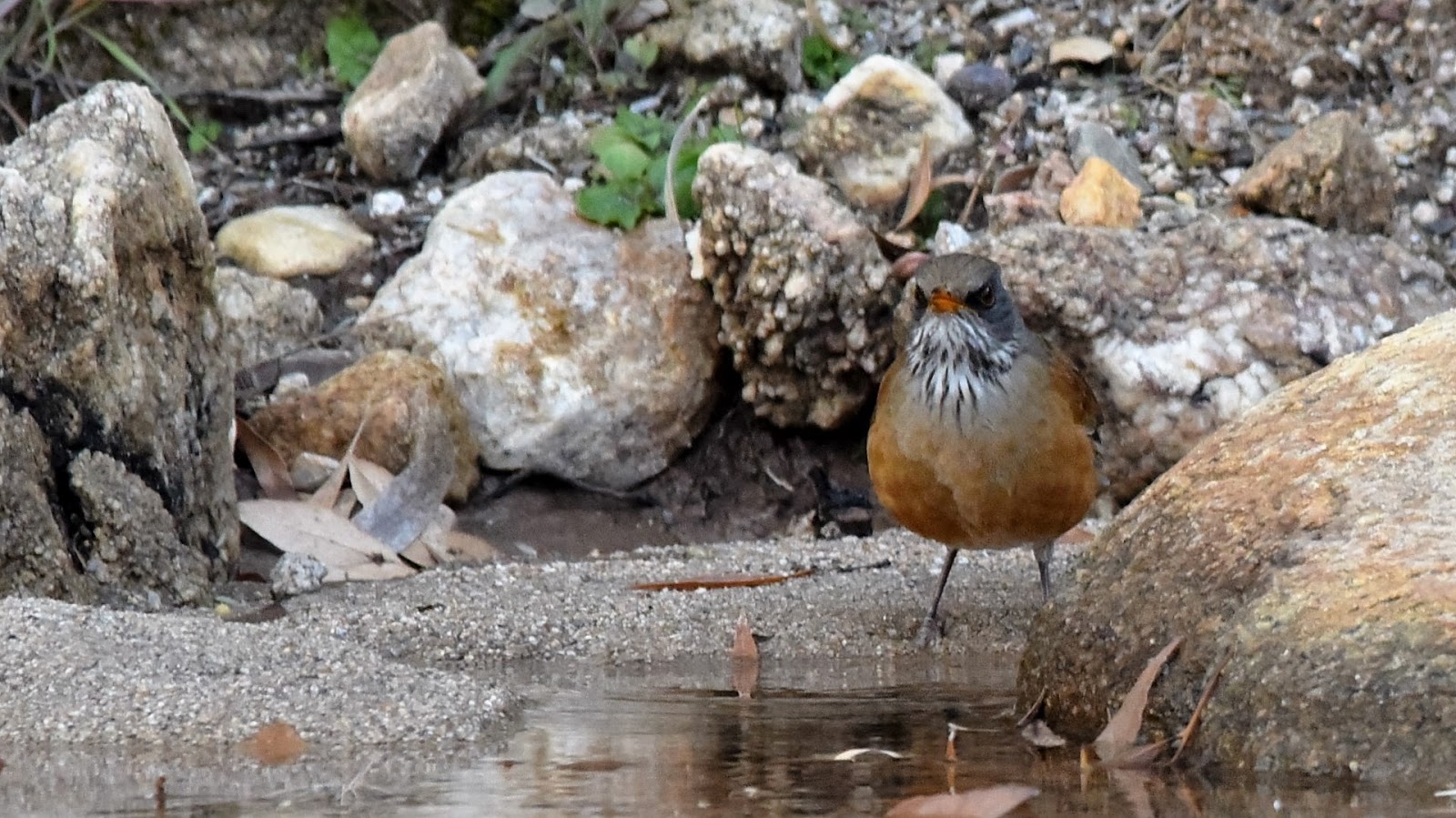
So, why we came to Ajo on this particular day is, as you guessed, a matter of a birdy importance. Our target? A Rufous-backed Robin, another unusual Mexican visitor. Just one of the three that had been reported here would be sufficient. And according to eBird, everybody who has come within 100 miles of Ajo has seen one.

Us? Not so much.

We arrived here a little past 10AM, and spent two hours walking the neighborhood, trying to scare one up. Every local knows the bird is here, because they've seen the crazy birders wandering about, and we have been asked several times if we had seen it yet ("If I had, would I still be here?" I wanted to reply, snarkily. But, thanks to the elbow of The Wife, I didn't.) Retreating to our trailer for lunch, we were interrupted by a couple of very nice retired ladies who knocked on our door, thinking they may have the bird in their back yard...but alas, it was a Cardinal.

Our current hope is that it will swing by later in the afternoon, maybe once the bars close for siesta.

And, so, we wait. And blog.

Patiently,
Me.

p.s. This is post #100 for the year! If you've read all 100, then you are My Best Friend! If you skipped a few, then no hard feelings... but go back and read them all if you want a Christmas Card. And click on an ad to truly redeem yourself.

Thursday, October 29, 2015

Laissez les bonnes oiseaux rouler!

Bonsoir from Louisiana!

My Ghost Blogger has been absent/lazy for a few days, so I apologize for the absence of posts. She has been fired for dereliction of duty, and a new Ghost Blogger will be hired soon. In the meantime, you're stuck with me.

I'm sure you've been wondering what has transpired since the last post. "What amazing adventures have they embarked upon, only to keep secret from their devoted followers?" is a question I'm sure you've asked yourself nightly. "Did they quit early and not tell anybody?" would be reasonable. "Do they not love us any more?" is undoubtedly also at the top of your mind.

To address these burning questions: Very Little, Definitely Not, and We Absolutely Still Do.

So, what has happened?

Mostly, the past several days have been about work and life. On the birding front, our only recent expedition was over to Marin, in search of two rare vagrants: a White Wagtail, an Arctic bird that we missed in Nome but that somehow ended up in Northern California, and an even more rare Dusky Warbler, which is common in Asia but has only been reported a handful of times EVER in NorCal. We struck out on the warbler, but did manage to find the Wagtail, for bird #671 for the year.

Candidate for "Crappiest Picture Ever". Blame Ms. Wagtail for not flying to our side of the lake.
The wagtail happened also to be The Wife's 700th Life Bird, so congratulate her on joining the 700 Club when next you see her!

Now, though, things are about to get interesting. We are in Cajun Country for a few days of jambalaya, gumbo, and boudin, and also for an interesting sounding festival called, "Yellow Rails and Rice". This festival takes advantage of how rice harvesting disturbs birds that are hiding in the wet rice to show attendees all kinds of rails, including the enigmatic Yellow Rail.

After that, we're headed to southern Texas (AGAIN) for a boat trip (AGAIN) and the Rio Grande Valley Birding Festival. Subsequently, we may visit the Most Boring City in America (Lubbock, TX) for a late attempt at Lesser Prairie Chicken, and then Denver for one more shot at Boreal Owl. Or, we may reschedule everything depending on the weather and our whims. That would be just like us.

Stay tuned!
Me (Not the fired Ghost Blogger, for reals)

Tuesday, September 29, 2015

The Jacana

I will give you three guesses as to the definition of, "Jacana".

Is it:

  1. A popular South American dance, made famous by the singer/dancer Charo in the 1960's.
  2. A cocktail, typically made with cachaça with a float of Midori.
  3. A bird not typically found in North America.
If you guessed #1 or #2, then I commend you for your creativity/gullibility. In reality, however...

It's a bird! They typically live from Mexico to Panama, and once in a rare while, they show up in Texas or Arizona for some unknown reason.

And there is one in Texas right now! And so are we! And we happened to be nearby, and found it today!


Look at those toes!

Woohoo!

Saturday, September 26, 2015

269 down, 96 to go

Days, that is.

Believe it or not, fewer than 100 days remain in 2015. For normal people, this is the time of year when thoughts turn to planning for the holidays, cleaning out gutters in advance of autumn rains, and dumping that lame quarterback off your fantasy football team, because he is sucking like a Hoover and a Dyson put together. For others, namely me, this is the time of year when desperation starts to set in.

You see, early in the year, every tree offers the promise of a new bird to find. Even well into the summer, we could drop into a new area and rack up at least half a dozen new birds, maybe more.

Right now, however, there exist only maybe 20 more bird species that we can realistically expect to find this year, with about another 30 or so that are possible but unlikely. These are spread around the entire country, with many of them appearing like Brigadoon, out of the fog for a day and then gone again for many years.

Tantalizingly, several of these have been around all year, or were here in spring migration, but we missed them. Now is our last chance, as we’re just running out of time! We either need to find a way to slow down the calendar, or have a run of amazing luck.

Some of that luck started this week. Reports surfaced of a Red-throated Pipit in Marin County. American Pipits are onomatopoeic, as they fly around spastically shouting, “pip-it! pip-it!” . This Red-throated fellow, however, only shouts “pip” and he’s not from America. Typically, he lives in Europe or Asia, so maybe this is how one translates “pip-it” into German or whatever? Anyway, with prompting and assistance from our friend, Alex, we spent a morning at the reservoir where the bird had been reported, and managed to track it down for bird #658 on the year.

What’s up next? Right now, we are outside of Chicago, spending the weekend chasing after the cursed Black-billed Cuckoo (again), as well as a few others. Then, we take a short jaunt down to south Texas (again), this time for a special tour to find a special little owl.


Keep your fingers crossed for us!

Monday, September 21, 2015

On the Kindness of Strangers

¡Hola, desconocidos!

First, an announcement: as of yesterday, this blog has served over 10,000 views for the year! Yay! Feel free to tell your friends about the wonder and glory that is Birds See'd! Post to Facebook and (most appropriately) tweet about it, and otherwise spread the word!

Right now, I'm sitting in a hotel in Tucson, our day of birding here rained out due to severe downpours, thunderstorms, and flash flood warnings. When all Hell is about to break loose meteorologically, one of the last places you want to be is high in the mountains!

That said, while the past couple days have been a bit stormy and unsettled, they have also been great for our bird count and for our general faith in humanity.

The friendliness of birders is something to which we have become accustomed. Compadres in the field are very willing to share information, advice, and even spritz of sunscreen or bug repellent. Such behavior is no longer surprising, and we do our best to reciprocate. When people go beyond this, however, it makes for an amazing and memorable time.

This story starts Saturday morning. We had finally tracked down the Sinaloa Wren after at least four attempts, with key assistance from another group of birders who showed us where his nests were and helped confirm that the brief bit of song we heard was really him. About 30 minutes south, we hiked up Hunter Canyon for our second attempt to find the elusive Slate-throated Redstart, when another birder stopped to point out where we should look.

To pass the dreadfully slow time, I made a reservation through Expedia at a B&B in Patagonia, AZ, where a Plain-capped Starthroat hummingbird had been reported recently. After a couple hours of waiting, the skies darkened to an ugly purple and distant sheets of rain obscured the mountains, and we gave up on the bird and headed to Patagonia.

When we attempted to check in, we found that the B&B didn't actually have any rooms available, but Expedia had booked one anyway and then didn't alert them that we were coming. Instead of just apologizing, they called other places in town, found us a room, and convinced the owner to waive his typical 2-night minimum stay. They even offered to buy us breakfast, since the place they found didn't offer meals! Thank you, Duquesne House!

Arriving at Casitas Frontera, we chatted with the owner about why we were in town. He knew the guy who owned the house where the hummingbird was appearing, and said he'd let him know we were coming. The owner also set out hummingbird feeders so we could watch the bats at night, and when we found he didn't take credit cards, he offered to let us mail him a check when we got home!

At about 6:30 the next morning, we walked a block to the house, and the homeowner was waiting. He invited us into our yard, which he had just mowed so that we wouldn't get bit by chiggers. He brought out some chairs, and invited us to wait as long as we wanted. And, since he was going for coffee, he offered to bring us back a couple lattes!

Fortunately, the Starthroat showed three times that morning, so the mix-up ended up working out great for us.

That afternoon, we joined up with Melody Kehl and her husband, whom we had hired to guide us to a Buff-collared Nightjar that had nested over the summer, and that we were hoping was still around. We drove for nearly two hours over pot-holed and rocky roads into an obscure canyon near the border. After the picnic dinner they provided, we spent a couple hours in the canyon looking for birds. At dusk, she brought out the flashlights, and when the birds called, led us through the desert scrub in the dark to their favorite perch. And sure enough, the huge saucer eyes of the nightjar reflected back the light from her flashlight and we had great looks! They got us back to the hotel safe and sound, and we had a fun time chatting with them.

Here's to all the cool people we've met on our year so far! Hopefully we get to meet many more of you!

Me

Sunday, August 16, 2015

Road Trip LA! Sailing and Soaring

Sí, otra historia de barcos,

Ever heard of Santa Catalina Island? We hadn't either, before we researched where we might find a Spotted Dove. Turns out, these little guys have made the 20-ish mile trek across the Pacific to one of the Channel Islands, and just a few days ago, a Helpful Birder reported a few of them on Santa Catalina.

Thus, we had a choice: head back to Compton and attempt to fit into the 'hood while searching the only mainland location they were reported recently, or take a cushy boat over to an island that's been described as reminiscent of a Mediterranean resort village? Hmm... decisions...

Day 4 of our Tour de LA began as so many other days have begun in the past few months: up before dawn, slurp down mediocre hotel coffee, then drive to a harbor.

With glassy waters and a few Shearwaters for company, we were at Catalina in just over an hour. And, the steep hillsides, notched with houses, surrounding a crystal blue harbor, does look like something you'd find on a postcard for the South of France:

The giant yachts in harbor are not shown in this picture, so as not to give you a feeling of inferiority, financial or otherwise.

The first reported location for the dove was vague: "in the village". But the village is only a few blocks square, so we decided to try wandering around to see what might turn up (and to pick a place for déjouner, mais oui). Pigeons, a few ravens, and the Ubiquitous House Sparrow were easy to spot, but no dove...until we checked out the downtown mini golf course (what, doesn't every European village have mini-golf?). Foraging near the windmill on the 4th hole, there he was!

12 minutes down, 6 hours and 18 minutes until our boat left. Now what?

A couple miles up the road was a botanical garden rated highly on Yelp, so we walked there to see some sights, and because 9:12am is a little early for lunch.

While the gardens made for good wandering, the highlight was an enormous memorial to William Wrigley, Jr., he of the chewing gum fame:

A tribute to a True American Hero, a man who figured out how to make millions of dollars from a substance you put in your mouth, chew to receive no nutritional value, and then spit out. 

Apparently, he was a huge fan of Catalina Island and invested a lot of money to make it a destination. He even had the Chicago Cubs do their Spring Training activities on the island for many years, which is why the island's barber is being interviewed about the Cub's playoff chances.

After a nice walk back to town and lunch at the harbor, our boat carried us back to Long Beach, with the accompaniment of dolphins this time:

Last one to the buoy has to go poke the Great White Shark in the tail!

The next day was our return home, and a shot at our last target for the trip, California Condor. The condor was actually declared extinct in the 1980's, as the wild population dwindled to zero and the last few were captured for breeding programs. Thanks to those programs, more than 400 condors exist today, of which over half are soaring free over California, Arizona, and Baja Mexico.

In California, condors can be seen over Pinnacles National Park, a few other areas around the Central Valley, and the Big Sur coastline. But, we didn't have time for all these places, so picked Big Sur given that it had the highest number of recent reports...but was that because condors were easier to see there, or because the number of visitors is higher, and so more eyeballs are looking?

After the LONG, windy drive up Highway 1 from San Luis Obispo, we had seen many vultures, ravens, and other dark soaring birds, but no condors. Pulling off the highway in the traffic jam around Julia Pfieffer Burns State Park, we noted two things: 1) OMG, we forgot how busy the coast is during the summer, even on a weekday, let's not do this again, and 2) a condor.

Yes, soaring directly over the entrance to the park, way up high, drifting between indigo blue sky and misty clouds, was an unmistakable California Condor, #633 for the year!

And so concluded our wildly successful trip south. Six targets, 100% hit rate, and only a few frazzled nerves. We were even starting to like the LA area...small parts of it, anyway... very small parts.

What's next? California's Volcano Country for mountain and forest birds, Nevada for an attempt at the famous Himalayan Snowcock, then off to Colorado for more mountain birds. 

Grateful to have no more boat trips in the near future, 
Me.

Thursday, July 30, 2015

2000 Miles For A Collared Plover! #birdinginsanity #yolo

Hola desde un lugar muy caliente!

Leaving SFO yesterday afternoon, our hearts were filled with trepidation and anxiety. We had spent a good chunk of change for a 48-hour, whirlwind trip to lovely McAllen, TX, in search of a rare bird that hadn't been reported on eBird or email lists in 48 hours. Would we find it, or was this plover just another windmill at which we were jousting?

As the plane climbed to 36,000 feet and the drink cart rolled by, we experience several changes of perspective, summarized thusly:
"It's not going to be there. Stupid bird. I hate Collared Plovers. In fact, I hate all Plovers. F-U Plovers. Look, Buddy, just hang around for a few more hours, say Hi, and we'll bring you some nice Plover-Treats. Dammit, why are we doing this? This is a stupid waste of time. Oh, well, it is what it is. Excuse me, ma'am, may I have another glass of wine?"
When our flight from DFW to McAllen was then delayed for an unspecified period of time because, "Your plane was broken, so we needed to bring over another plane, but now it needs to be inspected", our level of hope was almost at an all-time low. The nadir would be reached when we finally arrived at our hotel at 1AM, only to be told by the desk clerk, "Hmm... I don't see your reservation here."

Fortunately, that got resolved easily, and after a solid 5 hours of sleep, we were up bright and early to avoid the sweltering, humid heat and find our boy.

Did we find him? After a whopping 2 minutes of searching at the specified location, YES!
Snowy Plover in the front, Collared Plover on the shoreline. Did I mention that I hate Snowy Plovers, too? But, that's a rant for another time.
This is only the third record in Recorded North American Avian History of a Collared Plover here. They normally range from South America to southern Mexico, but one was reported in Texas in 1992, and the second was last year at this exact same pond, on the exact same shoreline. So, this bird is probably the same one that was here last year. I find it interesting how specific birds will end up somewhere completely out of their range, leave for a season, and then return back to exactly the same place.

What a relief!

Now, I need to figure out what to do with an extra day in South Texas...

Seeking Air Conditioning,
Me

Thursday, July 2, 2015

Blowin' In The Wind

A mis compañeros de ratas del desierto,

Perhaps nobody was more surprised than the tumbleweed.

Just moments before, it had been rolling along the desert contentedly, bouncing off fences and cactus and the occasional derelict building like tumbleweeds are wont to do. Then, it picked up speed as the heat-driven winds accelerated, bounded across three lanes of traffic, and was now milliseconds from being obliterated on the grill of my car.

While my surprise was no match for the tumbleweed's, I admit that I was not expecting the impact that shattered the poor tumbleweed into literally one billion pieces. Then again, I probably shouldn't have had quite so much faith in my ability to play Frogger with tumbleweeds during a blinding dust storm, surrounded by other cars and the occasional semi-truck, and with everybody else (not me!) driving just a bit too fast.

Here, we have captured this moment for your viewing pleasure:


A moment of silence now for the tumbleweeds that met their untimely demise somewhere around Casa Grande.


Thank you.

Now, the evening didn't start with a dust storm. We deplaned in Phoenix to a beautiful, sunny, 105F evening with perfectly clear skies. Only 30 minutes into our drive to Tucson, the skies started darkening as thick clouds of dust were blown up from the desert floor, and eventually we hit nearly black-out conditions.

The desert is a study in contrasts like these: bright, azure skies transition quickly to dark, brown dust. The landscape of rock and sand and thorny cactus that looks nearly uninhabitable is full of plant and animal life. And the time when the temperatures are hottest is also when most of the annual rain falls.

Monsoon season in the Sonoran Desert usually begins in July and continues through August, but it arrived early this year. So, days typically begin calm and clear, puffy clouds form around mid-day, and then thunderstorms attempt to batter you into submission from mid-afternoon until evening. Each day of our short trip south followed this pattern.

The good news is that we found our main target, an extremely rare Tufted Flycatcher! Not one, but two! Fewer than 10 have ever been recorded in the US, but this summer, two flew up from Mexico and decided to try to raise a family here. Can anybody say, "Anchor Baby"?

Tufted Flycatcher, sadly eyeing the throng of birders below, wondering when they will just GO AWAY, and whether he made the right choice to come to America.

The clump on the left is their nest, and you can just see the top of Mom's head peeking out!

The bad news is that we missed all the exotic hummingbirds we had hoped to see, and we got rained out the one evening we had to find a nocturnal bird, the nightjar. Sad face. So, we get to take another trip to Arizona in the next 6-8 weeks, as the birds will move back south to Mexico after August.

Our count is now at 594, just 6 shy of our original goal for the year (which we are thinking we should reset to a new target, since we still have 6 months of birding to go!). Next up: a long weekend in Tahoe! There are far, far worse places one could go birding, and with 10 birds in the area that we need for our year, there's a reasonable chance we could hit our goal soon!

Stay frosty,
Me

Saturday, June 27, 2015

Fools and Englishmen

Saludos fiesta gente!

The insanity has reached new levels, heretofore unparalleled in my personal existence. Yesterday, we drove 500 miles to go birding in 114F weather, to find a little gull who got lost, as so many do nowadays.

Now I'm not English (although some of my best friends are), so clearly Noel Coward was onto something.

In this case, however, it wasn't just any little gull, it was a Little Gull! This is a rare visitor to California, possibly from Asia, and has the distinction of being the smallest gull in the world. If you're a Bird Nerd, you would appreciate that this gull appeared to be only somewhat larger than a phalarope. If you're not a Bird Nerd, then please realize: there is still time.

Our target was reported earlier this week near the town of Lemoore, CA. Now we had never been to Lemoore before, but our first impression was positive. On the way into town, we passed Lemoore High School, which must be a FANTASTIC place to be educated because (A) there was an actual fireworks stand in the parking lot selling actual fireworks, and (B) across the street from the school is a restaurant named "Lolita's". Undoubtedly, that would have brought a tear to Nabakov's(*) cold, steel-blue eyes.

The one downside to Lemoore is that they apparently have The World's Largest Outdoor Furnace, and it was turned to SCORCHING. When we first arrived at the ponds where the gull had been reported at about 3PM, our car's thermostat read 110F. When we returned to the car after an initial failed attempt to locate our quarry, the temp read 114F. Fortunately, the furnace must have run out of hydrogen, as the mercury had "cooled" down to around 100F by the time we left at 6:30.

If you're curious about what a Little Gull looks like, glue your eyes to this pic:
Little Gull stares pensively into the mirror, contemplating his own mortality as he wonders what the Hell that was that died in the background.
If you'd like to see a little action, then check out this video we took with an iPhone through our scope (the gull is in the middle):


Now, there is clearly a lot going on here, much of which I attribute to Delirium from the heat:
  1. Our protagonist, the gull, is Riverdancing his way through the puddle.
  2. The tall pink-ish/orange-ish headed bird in the foreground, the American Avocet, is a drama queen, strutting about majestically, swiping its bill through the water with dramatic pauses. His stationary partner to the right, clearly embarrassed at this display, refuses to look at him.
  3. The small birds on the left, Wilson's Phalaropes, are playing Dizzy Bat, except without the Bat or the footrace that traditionally follows.
Fortunately, the temps didn't get any hotter, or who knows what deranged acts we may have witnessed?

Speaking of hotter, the next few days will find us in Arizona, chasing some exotic hummingbirds and a few other targets. We are visiting just at the beginning of monsoon season, so maybe we'll also get a terrifying torrential thunderstorm or two!

Hasta la vista,
Me


(*) Fun Regional Fact about Nabakov that I learned while doing extensive research for this blog post. Apparently, he lived in Ashland, OR for a while and finished the novel Lolita while there.