Showing posts with label Uncommons. Show all posts

Monday, November 30, 2015

New England is Adorable

Tomorrow we fly back to Tucson for the long drive home, with maybe a quick stop for one more bird. We had a few misses on this trip, but lots of success, and so we stand content with the results.

As we've been driving around quite a bit (about 1200 miles on the rental car in 7 days!), we've seen a fair amount of the New England area, from Connecticut up to Maine. And, for the most part, the thing that stands out is that it's so darn cute!

Towns have olde British-y names like "Peabody" or "Manchester-by-the-Sea", and people live on streets like "Old Straitsmouth Way" or "Bartholomew Avenue". Roads are gently curved and hilly, with rarely a straight line. There are Brooks, Necks, and Runs, and communities are called "Villages".

Lawns are impeccably manicured, and fences tend to be of the white picket variety.  Houses are clad in weather-aged shingles, or neatly painted clapboards of gray with white trim, both of which contrast pleasingly with the pale blue sky of a clear, cold winter's day. And even a modest-sized home is called a "cottage".

Nearly every angle presents a postcard-quality view.

But as quaint as this is, and "quaint" is very appropriately used in this context, there are a few downsides that we've discovered from spending a total of about 2 weeks here this year:
  1. Weather, specifically the Winter weather. We saw a sign today along a road that ran right beside a beach which said, "Caution: Drifting Snow". Snow drifts? Next to the ocean? That's just wrong. And it gets cold... despite being about the same latitude as Medford, OR, the average high temperature in Boston doesn't get much above 40F, and the lows are typically below 30F for the entire winter. Between the frigid temperatures and snow (remember, Boston received nearly 11 feet of snow last year!), many businesses, from stores to inns to restaurants, just shut down during the winter, some from November until May.
  2. Accents. For some reason, the New England dialect just grates on my nerves. If I never heard another, "Pahk the cah ovah theyah," I wouldn't feel that my life was worse in any way. 
  3. Lobster. OMG. It's so overplayed. Every corner store sells lobster, and it shows up on menus in odd ways because every restaurant must offer lobster but the chefs are bored to tears with Lobster Rolls and Lobster Bisque. So, how about lobster in an omelette? Or lobster ice cream? And, of course, you can purchase lobster t-shirts and lobster Christmas ornaments and even lobster-themed children's books.
Despite this, I highly recommend a trip here, especially if you take time to visit some of the museums and historical sites to learn about the history of this country. Just don't come in the summer,... May or October are so much less crowded.

Now, if you came here for a birding update, I will satisfy your vicarious curiosity: We found two new birds yesterday, both Life Birds for us. A flock of Purple Sandpipers perched and dozed in the sun on a seaweed-covered rock, and we were able to get within about 6 feet of them without scaring them off. And thanks to more eBird Detective Work, we discovered a King Eider, although it was about 1000 feet away and sleeping, so we didn't get the best of views of that one. I guess that will be an excuse to come back next year!

Off to have some lobster cocoa before bed,
Me

Wednesday, November 18, 2015

The Waiting Game, Part 2

Stupid robin.

We never did find that bird, despite spending hours hanging out and waiting, although we did convince the entire neighborhood we are insane, stalkers, or both. And did you know, you can purchase a nice 3 bed, 2 bath house in Ajo, AZ on a 1/3 acre lot for less than $100,000? Or that Ajo is the home to Arizona's first copper mine? These are the things one investigates when one is bored out of one's mind.

Our next destination was the San Rafael Grasslands in Southern Arizona, a beautiful valley of gently rolling hills located about 50 miles southeast of Tucson (although given the road layout, driving there from Tucson takes nearly two hours). Our goal is to find exactly two target birds at this place: Baird's Sparrow, a secretive little pest that we spent hours trying to find in North Dakota, and Short-eared Owl, which isn't secretive but is somewhat scarce and elusive.

We arrived late last night at a relatively nearby campground, Patagonia Lake State Park, which happens to be one of our favorite parks in Arizona for its scenery and proximity to birdy locations. This morning, the alarm went off around 5am local time, and after blearily making coffee, we headed for the hills.

A tip from the local birding email list suggested we start looking for the bird just after entering the grasslands. So, we pulled over about 100 yards past the intersection, and played our recording of a Baird's Sparrow.

After, oh, maybe five seconds, sparrow jumps out of the grass and flies to a nearby bush to give the invader a piece of his mind. A quick glance through the binos showed this:

Check! And this moment goes down in history as the fastest we've ever found a target bird.

But, now, we need an owl. They're usually only seen around dawn and dusk, and we didn't find one during the two hours we drove around the valley. Although we did see five cowboys rounding up their cattle into a pen. Grass-fed beef, anyone?

So, now it's mid-afternoon, and we're waiting. Again.

We'll try for the owl one more time tonight, and then on to Florida tomorrow.

For some reason, I think I want a hamburger for dinner,
Me

Saturday, October 31, 2015

Yellow Rails and Rice Is Not A Cajun Dish

On one level, the Yellow Rails and Rice Festival is a novel event that celebrates local birds and local culture. On another level, it's a triumph of "agri-tourism" where two groups that aren't often friends (Birders, who are often focused on preserving native habitats, and Farmers, who transform habitats to grow food) get together for mutual benefit. However you look at it, this is a pretty cool event.

Yellow Rails are secretive (and cute) little birds that like nothing more than to hunker down in some thick marshy grass and stay hidden. They stay so hidden that Science knows much less about the Yellow Rail than it does about most birds. But, we do know that they typically spend their summers in Central Canada and the Northern Midwest United States, and they migrate to the Gulf Coast in September and October.

Late October turns out to be the season for harvesting rice down here in southern Louisiana. And, rice grows best in flat, wet fields that Yellow Rails (and many other birds) find delightful. So, as the giant combines [pronounced with emphasis on the first syllable like "KOM-bine"] drive through the fields to harvest the rice grain, birds that have taken refuge in the field scatter. In fact, this kind of disturbance is one of the few ways that people can actually see a Yellow Rail.

So, about seven years ago, some enterprising folks in Southern Louisiana decided this could make for a great event: visitors get to see an elusive bird that they likely wouldn't otherwise get to see, and they also learn about how rice farming works, and hopefully appreciate both a little better. And since this is Cajun Country, why not throw in some food and music as well?

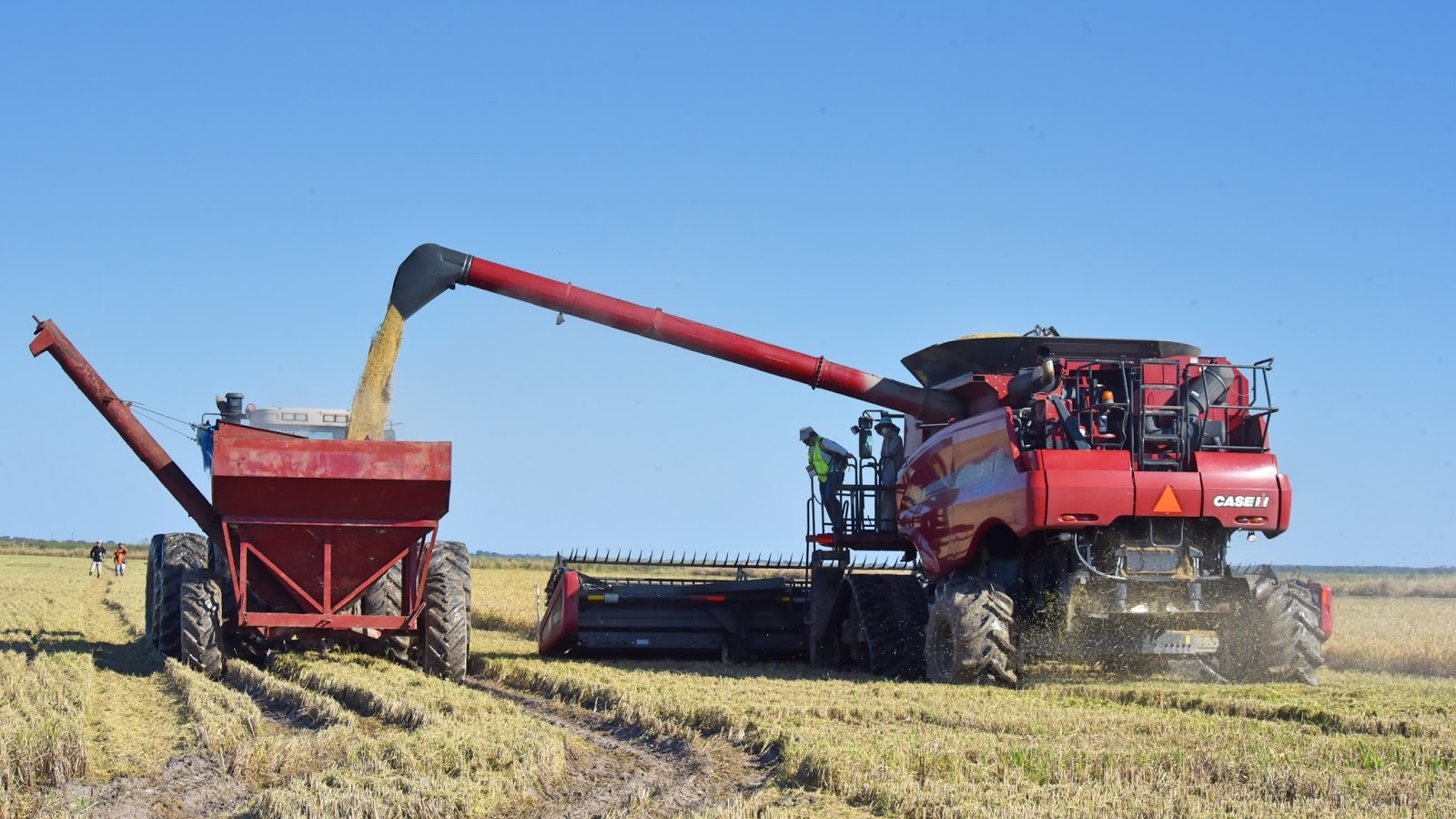
Thursday morning was Day 1 of the festival. We congregated at a church (get it? ha!) in a village so small that Google Maps doesn't even show it (although Bing Maps does! Bing FTW!), to receive instruction on how the day would go. The show then shifted to a nearby rice field, where the farmer fired up his giant combine.


This machine drives back and forth across the field, cutting the rice stalks, separating the grain, and blowing it into a hopper on the top. When the hopper is full, the rice is transferred to another vehicle for transport.


A very cool aspect of this event is that attendees get to ride on the combine! We were able to take two laps around the field, getting a monster's eye view of the whole process. Here's a view of how the machine works from the platform where the driver sits:


Otherwise, visitors are encouraged to walk through the (muddy) field to get close to the action, and the organizers had ATVs with which they gave rides alongside the combine.


From a birding perspective, we had many great looks at Yellow Rails, although it was tough to see the birds because they are small and understandably) were moving VERY quickly away from the huge beast:

Yellow Rail is in front of the third person from the right. Looks like only one person in that group is seeing this bird!

Zoom in to Yellow Rail
 Another view of a Yellow Rail:


We even had a few King Rails, a large fresh-water wading bird similar to Clapper/Ridgeway's Rail that's typically found along the Gulf Coast.


Mammals may take refuge in the fields, too, and they also run for new cover when the combine approaches.

This young raccoon didn't look very happy, both because of the impending machine and because we likely saw its parent on the other side of the field, headed the opposite direction.

While the mosquitos and related biting insects were surprisingly not bad at all, there was one slightly creepy element of the day: flying spiders!
The white lines you see are spider webs caught on electrical wire. Throughout the day, tiny spiders on the end of long strands of web (up to several feet long) were drifting through the skies and landing in the fields. Although, we never did actually see one running around on us, presumably they landed on us, too! Yikes!

The day ended with some really awesome jambalaya, sweet dough pies, cold beer, a local trio of musicians, and an amazing sunset. This was a really fun festival, and worth attending if you'd like to see some interesting birds and experience a unique part of the country!

Me

Tuesday, October 13, 2015

Adventures on the High Seas, Part Deux: The Slow Boat to Petrelsville

No other type of birding gets my heart beating like ocean boat trips. And, this isn’t the type of beating like, “I’m in love!” or “My team won the Super Bowl”. Rather, more like “I think I’m having a reaction to this seasickness medicine”. And yet, in the pursuit of Big Year Greatness, we continue subjecting ourselves to this.

So, Sunday morning, we ended up at the dock at Point Loma in San Diego at 5:30AM, watching a curious mix of people milling about while they prepared for their sailings: weathered old salts in rubber galoshes, bros with flip-flops and fishing poles, and an odd assortment of characters wearing hiking boots and khaki-colored North Face pants. We instantly knew which group was ours.

Our boat, a large, gleaming white fishing craft appropriately named, “Grande”, departed on time and chugged through the glassy San Diego Bay, past obvious reminders of the military presence. The juxtaposition of a submarine coming in to dock, with the lines of white headstones from Fort Rosecrans National Cemetery on the hill above, was a poignant moment:
You can barely see the headstones along the top. If only I had realized this at the time, I could have had a really nice shot... But you get the idea.

Cruising through the harbor was a slow process, but, we thought, maybe we are just in a "No Wake” zone? When our pace didn’t pick up upon reaching open waters, we knew we were in for a long day. That did mean less bouncing, which was nice, and more time to see birds as traveled, so...silver linings and all that.

Unfortunately, birding across the day was somewhat slow compared to what the guides expected. They suspected a primary reason for this was the unusually warm ocean temperature. Water temperatures ranged from 72F-77F throughout the 90-mile trip, which is about 5-7F warmer than usual. Since heat rises, warm water doesn't circulate downward as much, which means it tends to lack nutrients. No nutrients means no plankton, which means no animals that eat plankton, which means no animals that eat animals that eat plankton, etc.

The highlight of the day was a group of Least and Black Storm-Petrels that we located about 45 miles north of San Diego. Now, we had seen just a handful of these birds for the entire 7-8 hour trip at that point, when one of the guides said, "I think I see a raft of them in the distance!" The boat changed direction to head that way, and upon approaching the area, we saw several huge clusters like this:


Getting closer, the thick groupings of birds looked like this:


I believe they estimated the total number of birds at around 2500-3000 individuals, although counting was nearly impossible.

We could get fairly close to one group, and I got this picture:


Which I think has a couple nice comparisons of different birds. On the left side of the photo, I believe there is a Black Storm-Petrel next to an Ashy Storm-Petrel in the same wing position (the Ashy being the bird on the right with a lighter gray wing):


And on the right side of that picture, a nice comparison of a Least Storm-Petrel and a Black, with the Least being the tiny bird at the bottom-left, and the Black being the bird right behind her:


Least Storm-Petrels are about the size of a sparrow, so it's amazing that we found any of them in the open ocean!

So, two more birds added to our year total, which is SLOWLY inching its way up.

Next stop this weekend: Montana! Because, Gray Partridge!

Adios, y a ser un buen huevo!
Me

Saturday, October 3, 2015

Full-contact Birding

They say that Birding is for wimps. They say that Birders are the proverbial 95-pound weaklings of the Recreation World. They say that, "Those that can, do, and those that can't, sit in a lawn chair looking for an American Robin under a feeder".

Actually, I've never heard anybody say that, but I'm sure somebody thinks it. And, I'm here to prove that person wrong. WRONG!

A few days ago, we found ourselves in Norias, Texas, located about an hour north of Brownsville, or three hours south of San Antonio. In the Travel Haze in which we find ourselves, we aren't completely sure how we got there, but presumably it had something to do with the plane flight from Chicago. Or where ever it was that we were on Tuesday. Or whatever day that was.

We were in Norias, population Nobody, for a tour of one part of King Ranch. This ranch was founded in the 1860s, and is comprised of multiple huge tracts of land that, combined, are larger than the state of Rhode Island. The land is managed for cattle ranching and farming, but also has hundreds of thousands of acres left in natural conditions that are managed for sustainable hunting.

[Aside: It turns out that people (and corporations, which we know are people, too) will pay tens of thousands of dollars per year to lease land in the middle of nowhere where they can take their friends and business associates for a nice relaxing hunt. Who knew?]

While learning about that part was interesting, our motivation for taking the tour was to see a Ferruginous Pygmy-Owl. This species is fairly common in Mexico and parts south, but can only be found in the US in a few places in southern Arizona and south Texas. Rather than trekking through miles of desert on our own, we decided to hire a guide, and the King Ranch tour was an ideal way to get our primary target while also having a chance at something else rare.

We met our guide at the gate to the Norias Division of the ranch at 8am, and spent the next few hours driving dirt roads, learning about the ecology and history of the area, and stopping every few minutes at groves of oak trees to listen and look for the owls. As the sun climbed and the temperature rose into the 90s, the going began to get rough:

  • I stepped on a branch with 2"-long stiff and razor-sharp thorns. A thorn went through my boot and into my foot, and The Wife had to pull it out. While I looked away, of course. 
  • The Wife brushed past some kind of spiny plant, presumably an angry one with an attitude, and the plant furiously embedded several spines into her hand. We're still trying to get the last one out, two day later.
  • Hidden in the grass was a long stiff branch, which reached up and tripped our experienced guide, causing him to go sprawling, breaking the mount on his scope and drawing blood from his arm.

As he said, "Here in South Texas, everything bites, stings, scratches, or pokes, and that's just the plants!"

But we soldiered on, and finally after hearing a call, we plunged into the bitey, stingy, scratchy, pokey underbrush (while I'm thinking, "Snakes! Snakes!"), popped out into a clearing, and managed to get our scope and binoculars onto a beautiful owl. I would share a picture, except I didn't take any, as my camera feared for its life and refused to leave the truck.

We're home now, getting some work done and recharging before our next adventure, which is currently scheduled to be a pelagic trip (OH JOY ANOTHER BOAT) out of San Diego this coming weekend. But, since migration is in full swing right now, who knows what will pop up between now and then?

Adios,
Me

Monday, September 14, 2015

A Conversation

Hey! Long time, no talk! How’s things?

Have a good weekend?

Boring? Too bad. Mine had its moments. What did you do?

You’re right, that does sound… slow. But, could have been worse, right? You could have, I dunno, been chased by a swarm of bees or something!

Well, let’s see… we flew to Dallas, and then drove 350 miles to find a bird.

Yeah, and it wasn’t even that that exotic of a bird. It’s called a Buff-breasted Sandpiper. It winters in South America and summers somewhere up on the Arctic Circle, so it’s only in the Lower 48 during migration and we missed it in spring. We had to go back and find it because of this silly Big Year thing.

The flight was fine, but so much sitting!

Well, let me tell you. So, it’s Sunday morning. After driving over three hours from our hotel in Waco—

Yes, *that* Waco. But it’s been several years, so I think all the furor has died down. Now, it’s all about Baylor football. But anyway, we get to the place where the bird had been reported just the day before. It’s this turf farm—

Right, where they grow lawns? Lawns just don’t grow on trees, you know?

Well, anyway, so we’re driving slowly down a dirt road through the middle of this turf farm, scanning left and right for a small shorebird in the grass—

Yes, in the grass! Not on the beach! I know I called it a Sandpiper, but they like picking bugs out of the short grass. I don’t get to pick their names, you know?

So, we’re driving slowly, getting out to scan with our scope, but nothing. I mean, there are lots of birds flying around, but not ours. And somebody saw 200 the day before!

Yeah, 200! At least, that’s what they put into eBird. So, we reach the end of the road, turn around, and are slowly driving back. No piper. And we’re starting to get a bad feeling about this—

I know, right? It would have *totally* sucked to go that far and not find it! OK, so we’re about half way back to the main road, hearts sunk, spirits low, when I see something suspicious.

No, not a badger, something that looks suspiciously like this bird. Sheesh. Anyway, we jump out of the car, set up the scope, and are trying to make out the markings on it. They’re kind of far away and the light is super-bright, so seeing colors is tough. But then—

I’m telling you, there was no badger! But, then the wife says, “Umm… we should get out of here.”

I don’t know why she said it. Well, I didn’t at the time, because I was looking into the scope, but then I look around, and she’s starting to back away, and I hear—

Damn it, no, I didn’t hear a badger! I don’t even know what a badger sounds like. Anyway, I hear buzzing.

Yes, buzzing. So I’m looking around, and then I see this giant cloud coming our way. It was bees!

Yeah, a whole giant freaking swarm of them! And we’re in the middle of a gi-normous lawn, with nowhere to hide.

Well, we did what any sane person would do, and we ran! Through the edge of the swarm! We only had to run maybe a hundred yards or so and then we were out, but it was freaky!

Seriously. You’re right, they probably were Killer Bees, or at least I’m saying they were! I beat Killer Bees!

It only took a couple minutes for the swarm to pass, then we ran back to the scope and tried to find the birds again.

For some reason, the swarm and our running didn’t seem to phase them, ‘cause they were right where we left them. I think they were even a bit closer. Maybe they wanted to see us get eaten?

Revenge for their brothers and sisters, the chickens? Anyway, we took like a bazillion pictures and studied them carefully, and yep, it turned out those were our birds! Success!

Thanks. Then, we literally had nothing to do. Our flight didn’t leave until today and rebooking was too expensive, so we stopped over at Austin for the night, had a good dinner and slept in.

Baltimore! I’m actually calling you from the Dallas airport right now, and we board soon.

Another stupid bird, of course.

It’s called a cuckoo, a Black-billed Cuckoo to be specific.

Maybe because it’s got a black bill? You’re impossible. I gotta run, flight’s about to board.

Later!


Tuesday, August 25, 2015

Agony and Adventure at 12,000 feet

This weekend found us in the Rocky Mountain state, with one primary goal: to find an elusive White-tailed Ptarmigan.

Our destination? Rocky Mountain National Park, specifically the Alpine Visitor Center. Located about 25 miles west of Estes Park, the visitor center is at nearly 12,000’ elevation and is close to a trail where the Ptarmigan had been reported lately.

The beginning of the trip on Thursday boded poorly. Flight delays on both legs of the journey and a missed connection meant we arrived at the hotel at midnight instead of 6pm. We had to wrap up some projects the next morning so didn't get out of the hotel until noon, and then I nearly broke a toe walking to lunch. Fort Collins City Planners, why would you put a 4” high planter box in the middle of the sidewalk and not paint it something visible? So, both Thursday and Friday were devoid of birds.

Saturday, we arrived at the visitor’s center at 9am when it opened, interviewed rangers about where to look, then were off to trailhead just down the hill.

The trail had a few ups and downs and was only a half-mile long, so it didn't look challenging. Except, there is literally no oxygen at that elevation. A match won’t stay lit, there’s so little oxygen. For reals.

So as we gasped along, we paused frequently to suck down as much air and scenery as we could. Ptarmigan Pterritory was very beautiful, in a way. The mountain slope was blanketed with tundra, a treeless biome consisting of low and thick mats of grass, moss, lichen, and other small plants no more than a few inches tall. We counted at least a dozen varieties of tiny wildflowers, in blues, yellows, and oranges. The plants were interspersed with small granite rocks and outcroppings, and a few marmots watched us curiously from the boulders while we wandered about.

An example of tundra. Note the lack of shrubs or trees. Oh, and some Bighorn Sheep.

A cute, chubby little marmot on the lookout.
Then, we reached the end of the trail. We were surrounded by about one square mile of steep tundra, in which, the rangers told us, were at least 1 momma ptarmigan and 3 chicks. Shouldn’t be too hard to find them, right?

Well, let me tell you this about that.

The day was sunny, but W-I-N-D-Y. Wind speed at the visitor center gusted up to 25mph, but the trail area was windier and became progressively worse as the day wore on. And this wind was cold; it was a bully of a wind, the kind that slaps you in the face until you cry, then whips the tear off your face before it even reaches your eyes.

And, about ptarmigan: because there is no cover for them to shelter in, they have to hide in plain sight. They can sit motionless for hours, and in the summer, their feathers are camouflaged to look like rocks:

From Flickr user Bryant Olsen, You can see the similarity between the rocks and the ptarmigan. No offense intended, Mr. P
As we stood, sat, wandered, and waited for the little beasts to show themselves, other birders came and went. The sun rose higher in the sky, and the wind accelerated its abuse. Still, no bird.

We returned to our car around noon for lunch, then out to the end again. As we hunted, we found plenty of ptarmigan feathers… maybe they were all eaten? How many feathers would we need to find to recreate a ptarmigan and thus be able to count it?

Back to the car for a break, then when the winds died down at 4pm , we gave the birds another shot. Note that I do not literally mean we attempted to shoot the birds, although I would have considered it at that point. I was already imagining t-shirts with slogans like, “Ptarmigan: it’s what’s for dinner” and “Ptarmigans are Ptasty”

Another 90 minutes, and nothing. So, down the mountain we went, disheveled and dismayed.

The next morning, we tried again, this time arriving at 730a. (early bird, etc, etc)

We were joined by several other birders, and also two prairie falcons swooping about. At first, this was dismaying (the falcons, not the other birders, although all of us became more depressed as the morning wore on). We were concerned they (again, the falcons) would scare the birds into remaining even more motionless. Then an idea struck me: there were 3 chicks, so if the falcon gets one, then that would give away the location and we could see the other two! I know, grim, right?

Around 9am, everybody else had given up, and we wandered back to the Visitor’s center for another consult with the rangers. We needed more details after 9 hours of searching and finding nothing…where were they seen along the trail? What time? Upslope of the trail? Downslope? What if the wind was really blowing? The ranger’s response… “Um…I’ve just seen them all over the place.” OK, thanks?

Now, we came all the way here for a ptarmigan, so we were not leaving without a damn ptarmigan. Back to the trail!

As we marched down the so, so, so familiar path, we ran into a couple we had seen earlier, hiking up from somewhere lower on the hill. (Note to Rangers: Everybody saw the signs instructing people to stay on the trails. In no way did anybody looking for a ptarmigan ever veer from the trail. Certainly not. No matter how this account makes it sound.)

“Well, we hiked all through the lower area and didn't see anything. Do with that what you will.”
They looked and sounded like competent birders, so we decided to trust them and focus on the upper area for our fifth trip out.

I was almost to the end when The Wife came into view, running down the slope as best one can when the slope is covered with ankle-catching plants and toe-stubbing rocks.

“I think I hear something!”

We gently trudged up the steep mountainside, our ears peeled. We hiked left. We hiked right. Then left again. Then, I heard something, too. To my ears, it was like… Squabbling? Arguing? Annoyance?

Scanning the rocky field below us, I saw them! At least three birds, jumping on each other and cackling as they worked through their disagreement.

Can you find the birds in this scene? (click to enlarge if you wish)


Stumped? Here's a closer look:

Victory!

The rest of the weekend consisted of driving around Colorado, chasing reports of Buff-breasted Sandpiper and other rarities. We struck out, but the jubilation of tracking down the ptarmigan made up for it. And, we got upgraded to First Class on the way home. Double Yay!

So, we have about 72 hours at home, and then we're off to our next destinations: St. Louis and then Boston. Frequent flier miles galore!

Friday, August 21, 2015

Are You Experienced? Part 6: The Snowcock

Near the end of the movie, "The Big Year", two of the main characters, Stu and Brad (played by Jack Black and Steve Martin) decide to work together to defeat their nemesis, Kenny (Owen Wilson).

They agree to attempt finding Himalayan Snowcocks living in the Ruby Mountains of Nevada. Given they are short on time, the two new friends hire a helicopter to take them into the mountains, at which time Brad utters the memorable line, "The Snowcocks are on me!". Cut to scenes of them coptering around snow-covered peaks, laughing and having fun the entire time.

In real life, this episode plays out much differently. Much, much, differently. Enoughly different to make the birder who has experienced this pursuit grumpy, and to declare grumpily, F-U Brad and Stu!

First, there is no helicopter. There is never a helicopter. Nobody does that. Did I say "F-U Brad and Stu" yet?

Instead, you hike 2 miles up a narrow, rocky trail in the with 1,000' elevation gain, ending at 9,700' above sea level. In fact, not only must you do this without oxygen, you must do this without daylight and starting at 3am, because the damn birds start calling at dawn and then only for a short while after. (Key learning: Snowcocks are a pain in the ass.)

So, second, you need the proper gear. This could include many items depending on your predilections (for instance, you may or may not have a Thermos of coffee, and it may or may not have whiskey added). At a minimum, I recommend a flashlight; see above regarding daylight. Oh, and test your flashlight before you leave home.

In our case, we brought 3 flashlights. We didn't test them until arriving at the campsite. When we tested them, the batteries of two had leaked and corroded the flashlight to the point of non-operation, and the third had a burned out bulb (oh, and the spare was missing). While I'm at it, F-U batteries.

Fortunately, we had a small lantern that was actually functional, so weren't completely dead in the water.

Third, you need to know where you're going. The specific trail is the Island Lakes trail in the Ruby Mountains of Nevada, about 45 minutes south of Elko.

When you arrive at the parking lot, you will see a sign that says, "Trailhead", and then a smaller sign that says "Trail":

In our case, we arrived at our nearby campsite (Thomas Canyon, a fantastic campground) at dusk the prior day, we hadn't investigated this yet. So, we saw the first sign by our headlights and then walked up to the distant sign with our lantern.

It reads:

Where you stand, there is a trail that goes left, and another one that goes right. But, the sign is oriented vertically, so it doesn't match where you're standing. What to do? We went right.

So, we started hiking with our "Little Lantern That Could", stumbling and bumbling over rocks and stream crossings. We reached one small lake (hmm...), then another (hmm...), then finally arrived at a large lake at the base of a cirque. The sun was just rising, but we didn't hear anything. We waited and waited, with the waiting being punctuated with a gust of wind that blew my hat into the lake (big props to the wife for wading in to get it!).

Finally, around 8am, we decided that we'd missed the birds, and trudged back down the hill, dejected at having rising at 3-effing-am-in-the-effing-morning and gotten no results.

Arriving at the truck at 10am, we drove around the parking lot and were about to rejoin the main road when we saw this, about 200 yards away from the "Trailhead" sign and the trail we walked, and parallel to the entrance road:


Wait.... wha-wha-wha-what's that say?


First, there was dead silence in the truck as we contemplated this sign. Then, as you may imagine from the tone of this post, a few choice profanities were uttered. To be honest, more than a few. And it felt good.

So, we had gotten up early to hike the LAMOILLE LAKE TRAIL in the dark, a trail where Snowcocks have been reported only twice in the past two years, and NOT the ISLAND LAKE trail, where they are reported PRACTICALLY DAILY. The obvious Trail signs showed both paths starting from exactly the same point, so we didn't even think to wander around the parking lot looking for another trailhead!

@USForestService Your sign-making skills suck. I hate you.

Hopeful that maybe, just maybe, the birds might still be findable, we parked and hiked another 2 miles and 1,000' up, and waited another hour. But, no dice. Did I say "F-U Forest Service" yet? Sort of, but not really. So: F-U Forest Service.

So, 8 miles and 2,000' of elevation later, all we had was tired legs. And, the opportunity to do the hikes all over again the next morning.

Day 2 was without drama, however. Our lantern battery didn't die, and the trail was easier to hike having done it once. Around 5:15am, the birds did start calling, and we listened to them for over an hour. We never could see them on the distant hillsides, but the calls were very cool to hear.

And, shortly after daylight, a large bird flew into a nearby tree. Redirecting our attention to it, we waited a few seconds for her to peek out from the tree, and then were delighted to discover it was a Dusky Grouse! Another bird we needed for the year!

And, the scenery was gorgeous:


In the end, we got two birds for the year and plenty of exercise, and two days hiking at nearly 10,000' was good training for our upcoming weekend in Colorado to find Ptarmigans.

All's well that ends well, I grumpily admit.

But still, F-U Brad and Stu.

Off to the Rocky Mountains,
Me.


p.s. The Gentle Reader might think quietly that the problems were actually all our fault, since we didn't test our essential gear before leaving home, didn't explore the trail in the daylight, and didn't put any GPS markers on any of our devices to suggest to us that we were on the wrong trail.

To this I would say, I am an American, and like any good American, I choose to blame all my problems on the failings of others around me. So, keep those, "You make your own bed" thoughts to yourself and back off, buddy!


Tuesday, July 7, 2015

The Final Countdown?

As of last night we were at 597 birds for the year. What happened today?

We struck out all morning, driving miles and miles down bumpy dirt roads trying to find any of 10 birds reported in the Truckee area that we needed for the year. But, to no avail.

Then...at 4:15pm, we climbed 200 feet up a dusty slope in the area of a past forest fire, and after an hour of looking, stumbled upon a White-headed Woodpecker! #598!

At 6:30pm, we drove the roughest, rockiest road of the day to Sage Hen Campground because of a recently reported Calliope Hummingbird. Thunderstorms were building and the sky darkened, so we had to move fast. Reaching the parking lot, we made a beeline for the nearby creek, and within 5 minutes found a beautiful male Calliope hovering over some willow bushes! #599!!

Jubilantly, we returned to Truckee for dinner, believing our night was done but satisfied in finding two birds on the day. Then, over dinner and a glass of wine, we reviewed the list of recent sightings and found that one of the campgrounds we visited had four recent reports of a Flammulated Owl. Should we try for it? Our first instinct was to turn in for the night and resume early in the AM, but then again, how badly did we want our goal?

Driving back north, we arrived at Cottonwood Campground at 9:45pm. To a dead silence. Except for the nearly constant stream of traffic that sped by for some unknown reason (seriously, people, what is so important in Sierraville, CA that everybody in Truckee needed to go there?).

At 10pm, nothing. 10:15pm and 10:30pm, likewise. 10:45pm, we began to wonder why we wasted the gas, and started whispering about how much longer we were going to sit there.

Then, at just past 11pm on July 6, 2015, a distant single "hoot"! A few seconds later, "hoot" again! And then several more! Flammulated Owl!

Please press Play on the video below:

Not only did we hit 600, but we hit it out of the park with a Life Bird!

Tomorrow, we'll try to push our total past 600 with a few other birds near Tahoe, then back home to prep for a weekend in Carolina.

Sipping on scotch but no cigars (the hotel is non-smoking!),
Me

Friday, April 24, 2015

Addition by Subtraction and then More Addition

Queridos amigos amigables,

I reach out to you from Laredo, Texas, with tales of joy and dismay wrapped in a single day, like an overstuffed messy burrito from that little shop in the Mission; you feel bad and a bit guilty at first, but then you can't wipe the smile from your face as you dig in, even if you can wipe off the guacamole. And thus, similes and sentence length have been stretched to their limit, like the tortilla wrapping that burrito. 

You may wonder what all this has to do with birds, and I will get there eventually. Just like you eventually get to that bit of tortilla and sour cream that is wrapped in the bottom of the aluminum foil encasing your burrito.

The day began with a sad, sad email from a volunteer at eBird about our putative Hook-billed Kite. Her dagger:
"The bird at the bottom is a Broad-winged Hawk without a tail, and I have to say it is a very odd looking bird!"
This made us sad, like when you discover that, despite clearly asking for extra jalepeños on that burrito, that there are actually NO jalepeños. Bummer! No Hook-bill!!

We considered drowning our sorrows in a pitcher of margaritas at lunch, but decided to stay frosty. We might be needing our senses, like when your burrito has a beautiful garnish of cilantro and crema, and that spicy chipotle chicken, and yet the mariachi band is approaching.

This turned out to be the right decision. Unlike tipping the mariachis.

Driving west from McAllen, we took a left turn at San Ygnacio in our umpteenth attempt to find White-collared Seedeaters. You see, we have looked and looked and looked for these damn birds, and have struck out every time. And this isn't walk-in-a-manicured-park-in-perfect-weather birding. This is usually 90F-and-90%-humidity-walking-through-overgrown-area-on-banks-of-Rio-Grande-under-watchful-eyes-of-Border-Patrol birding.

While other visits have been unkind, today was different.

No kidding, we parked, walked down the hill to the banks of the Rio, paused to listen, and heard the birds calling. We walked 100 yards down the trail, looked up, and there was our first Seedeater!


Was this Birding Karma paying us back?

Like when that little place in the Mission apologies for forgetting the jalepeños and brings you a free side of guacamole.

Salud,
Me

Thursday, April 23, 2015

Spray and Pray

Buenas noches, mis lindos pequeños bandidos,

McAllen, TX is a hot, steamy conglomeration of shopping malls in an otherwise hot, steamy but low-budget area. It's the largest city in south Texas, and has become a mecca of retail therapy for both Texan Fashionistas and well-heeled Mexicans. Now go forth, and consider yourself informed.

We happen to be in McAllen (again) because certain birds love this climate. Wild guess, but I assume they aren't here for the Saks-Off-Fifth or Cavender's Boot City...a better guess would be the plethora of bugs, dense brushy cover, and aforementioned hot-n-steamy weather. All of which explain why we'll be getting out of here soon!

Our recent birding adventures have continued to turn up one new bird after another, albeit at a slower pace than before. This is causing us to try new techniques, at which the Birding Purist (and you know who you are!) may cringe.

I have dubbed my favorite technique, "Spray and Pray" (which is ironically appropriate given the evangelical bent of the region). In this technique, the brave/lazy birder aims their camera at a possible target, blasts a bunch of pictures, and then reviews the pictures later to see what they hit.

Does this technique work? Believe it or not, sometimes, your prayers do get answered.

Exhibit #1:
What chu lookin at, Willis?  (betting nobody under 40 gets that reference...)
Now, we knew that we had a number of Green Parakeets, which have entirely green bodies. We didn't know until we reviewed the picture, however, that they had been joined by a Red-Crowned Parrot (you may need to zoom the pic to see that the middle bird, staring at the camera, has a red forehead).

Note also that some of the pictures we took that night highlight one of the major cultural problems sweeping America today: Public make-out sessions by Parrots. In this particular place, there were probably 500 parrots lined up on the electrical wires, most of them in pairs. And, most of them were shamelessly snuggling and kissing, like this set in the middle:
Get a room!
I could not tell you what the upper-left parrot is doing. But I digress.

Exhibit #2:

One of the tricks-of-the-trade for raptor identification is to look at the silhouette of the bird. Since details of feather color can be hard to see from 1000-2000 feet away, other clues like the shape of the wings and length of the tail are needed.

In this case, we believe the bottom bird is a rare Hook-billed Kite, based on the very round, paddle-shaped wings, [4/24 update -- it's not :-(  An expert said that it was a Broad-winged Hawk missing his tail feathers] (He's joined by 3 Broad-winged Hawks and probably 1 Mississippi Kite a Sharp-shinned Hawk, if you care. Which I know you do.) There are fewer than 50 breeding pairs of these birds in the US, and all of them are located within 20 miles of McAllen. None had been reported recently, so we didn't even think we would see one. And, this was literally a random blast of the sky. We're waiting to hear back from the local record-keepers to confirm our guess, so hopefully I won't have to edit this blog post in a few days! [4/24 update -- I'm editing :-( ]

Now, you can question the validity of counting this bird, since we didn't know we'd seen it at the time. However, we did see the sky with the bird in it at the time the bird was there, and we did ID it from the photo, so to our ethics, this counts. If you don't think we should count it, then just track your own damn list, and keep your hands off our rights to bear 400mm lenses!

Stay frosty,
Me

Sunday, April 12, 2015

Fast and Furious

Greetings from Galveston!

Actually, we're not in Galveston. But from here, we can hear her seawinds blowing and see her seabirds flying in the sun. We're just a little north, on the Bolivar Peninsula, which is close enough for horseshoes and birding, I say.

Today was another marathon in a string of 26.2's. We rose at 5:30am, were on the road by 6am, and didn't relax until dinner at 8pm. In between those times, we battled rain, another series of thunderstorms, 120 miles of freeway through the middle of Houston, more rain, ravenous and dastardly mosquitoes, and there may have been a new bird... or twenty.

That's right, we picked up *twenty* new birds today, woohoo!

The first few birds came on a visit to the Attwater Prairie Chicken National Wildlife Refuge, where we took a tour to see the eponymous fowl do its version of the Chicken Dance.

FYI, the Attwater's is possibly the rarest bird in North America. The refuge estimates that in 1900 there were around 1 million individuals, and now maybe 100 or so remain in the wild, which actually is double the population from 10 years ago. Turns out that we value prairie more as tract homes and strip malls than we do as habitat. Oh, and bringing fire ants to America, which consume all the insects that the baby chicks eat as well as the chicks themselves, probably wasn't the best of ideas. And frankly, the male birds themselves are pretty dumb... they insist on doing their mating dances in the middle of open spaces, so they're easy targets for hawks.

After that ecology lesson, we relocated about 120 miles east to our current campsite, passing such fine businesses as Daquiris To Geaux and Darque Tan ("the finest chain of luxury tanning salons in the world") as well as an inordinate number of gentlemen's clubs and churches, often not that far from each other. Texas!!!

Around 4:00pm, having checked in and dropped our trailer, we headed north to the famous High Island, one of the richest birding areas during spring migration, for a little evening excursion. The area is just a few inches higher than the surrounding land, which makes the difference between supporting only small shrubs vs. huge trees. Birds flying up the coast see that oasis of oaks and dive in for a respite, which concentrates them in a fairly small area.

Today, after the recent storms, there were a ton of birds and probably 100x the mosquitoes. Despite long-sleeve jackets, long pants, boots, and a DEET bath, at times we held out binoculars with one hand, while slapping pests with the other.  Yet in one stretch, we averaged finding more than one new bird species per minute!

With all that, our tally has jumped to 424, which crushes our prior personal best of 406. Not bad for a couple of amateurs...

For the next few days, we're going to hang in this area and see what the weather does. As of now, thunderstorms are supposed to rumble around through Saturday, so we'll see what that does to the migration itinerary.

Until next time,
Me

Tuesday, April 7, 2015

Are You Experienced? Part 4

Dear Loyal Readers,

Today is the day for which you have been waiting your entire life, or at least for 2 days. Did they succeed in seeing the endangered Gunnison Sage-grouse? Or did they fail spectacularly, as with the infamous and despised Brambling? And, more importantly, how can I see this fascinating bird?

Allow me to start with the last question first.

The Birding Experience, Ten Steps to Seeing the Gunnison Sage-Grouse 

  1. Drive somewhere in the vicinity of Gunnison, Colorado. Unfortunately, it’s not called the “Las Vegas Sage-grouse” or “Someplace-I-Would-Actually-Plan-To-Visit Sage-grouse”. 
  2. The morning of your viewing experience, rise at least 2-3 hours BEFORE dawn. So, if dawn is 6:30AM, plan on rising around 4AM.
  3. Bundle up! You’ll be sitting still for 3-5 hours. Oh, and pack something to do that doesn’t require Internet access, as there ain’t no coverage out there in the boondocks.
  4. There is a place where the grouse meet to dance and attract mates (refer to prior blog post for scientific details) with a parking area built by local volunteers. You must arrive at the parking area at least 1 hour before dawn. Arrive later and you risk scaring off the precious little darlings, ruining your experience, as well as the experience of everybody else who is following these same precise instructions on that day. You wouldn’t want to be Debbie Downer, would you?
  5. After you arrive, roll down your windows and get comfy in your car. You will be sitting from the time you park until the birds decide they’ve done enough dancing and fly away. You could be here a while…
  6. Shhh! Don’t make noise! Grouse be sensitive.
  7. Brrr! It’s cold. Snuggle up in that extra blanket you brought, as you can’t run your car’s heater. Noise, remember?
  8. Watch carefully. You’re looking for something that resembles a rock in the middle of the field, or a pebble on top the nearby ridge.
  9. When/If they arrive, prop your scope on your car door and observe closely. If you’re lucky, you may even see them get down and dirty. If you’re not lucky, then at least enjoy the sunrise.
  10. When the guide gives the OK, then you can leave your car to use the portable toilet or drive away. But not before then! So…there should probably be step 3.5, Be sure to use the restroom before you leave your hotel! (but that would be step 11, so I left it out)

So, did we see them? Yes! We got reasonably close looks at one, and saw three others in the distance. But, unfortunately they didn’t boogie.

But, SHOULD we see them? They’re endangered after all, and human activity disrupts them. Would YOU go see them?

That, Loyal Reader, is up to you to decide.

But, at least you now know what you’re getting into.

Adios,
Me

Thursday, January 29, 2015

We're not in California any more

Yo!

Salutations in your general direction! This communiqué is being crafted from Emporia, KS, about 100 miles southwest of Kansas City, and home of the great Emporia State University and their Lady Hornets, winners of the 2010 Division II Women's Basketball Championship, or so signs around town proclaim.

Why are we in Emporia? I'll get to that in a minute.

The theme of this week has been, "Get up freaking early". Wednesday, we got up early for a chase of the Copper Bird:

This is actually a Lewis's Woodpecker, but I think old Meriwether was a little full of himself.
Their chest is actually pink, but when you shine early morning rays of very red light on them, they change to copper!

We easily found them over in Vacaville thanks to reports submitted to eBird. In fact, we literally drove up to the tree in which they were sitting (the Brambling should take a few tips on proper bird etiquette from them).

Thursday, we rose at 4AM for our flight to Kansas City. We're in Kansas for the next few days to find birds that winter down here, but spend their summers in remote parts of the far north (like, Artic Tundra/Polar Bear/Midnight Sun north). While Kansas in the winter might feel like the Arctic to those of us from California, it's presumably a little easier to get to than Nome, AK.

Thanks again to eBird, after leaving the airport, we headed straight to a remote field where they had been reported recently. After only a few minutes of looking...success! Lapland Longspurs!

Looking slightly confused, probably about why she's in a remote, barren field in Kansas

Girl on the left, boy on the right
Is it cheating to use eBird? Well, I will admit it makes things a whole lot easier!

TTYL,
Me