Saturday, October 31, 2015

Yellow Rails and Rice Is Not A Cajun Dish

On one level, the Yellow Rails and Rice Festival is a novel event that celebrates local birds and local culture. On another level, it's a triumph of "agri-tourism" where two groups that aren't often friends (Birders, who are often focused on preserving native habitats, and Farmers, who transform habitats to grow food) get together for mutual benefit. However you look at it, this is a pretty cool event.

Yellow Rails are secretive (and cute) little birds that like nothing more than to hunker down in some thick marshy grass and stay hidden. They stay so hidden that Science knows much less about the Yellow Rail than it does about most birds. But, we do know that they typically spend their summers in Central Canada and the Northern Midwest United States, and they migrate to the Gulf Coast in September and October.

Late October turns out to be the season for harvesting rice down here in southern Louisiana. And, rice grows best in flat, wet fields that Yellow Rails (and many other birds) find delightful. So, as the giant combines [pronounced with emphasis on the first syllable like "KOM-bine"] drive through the fields to harvest the rice grain, birds that have taken refuge in the field scatter. In fact, this kind of disturbance is one of the few ways that people can actually see a Yellow Rail.

So, about seven years ago, some enterprising folks in Southern Louisiana decided this could make for a great event: visitors get to see an elusive bird that they likely wouldn't otherwise get to see, and they also learn about how rice farming works, and hopefully appreciate both a little better. And since this is Cajun Country, why not throw in some food and music as well?

Thursday morning was Day 1 of the festival. We congregated at a church (get it? ha!) in a village so small that Google Maps doesn't even show it (although Bing Maps does! Bing FTW!), to receive instruction on how the day would go. The show then shifted to a nearby rice field, where the farmer fired up his giant combine.


This machine drives back and forth across the field, cutting the rice stalks, separating the grain, and blowing it into a hopper on the top. When the hopper is full, the rice is transferred to another vehicle for transport.
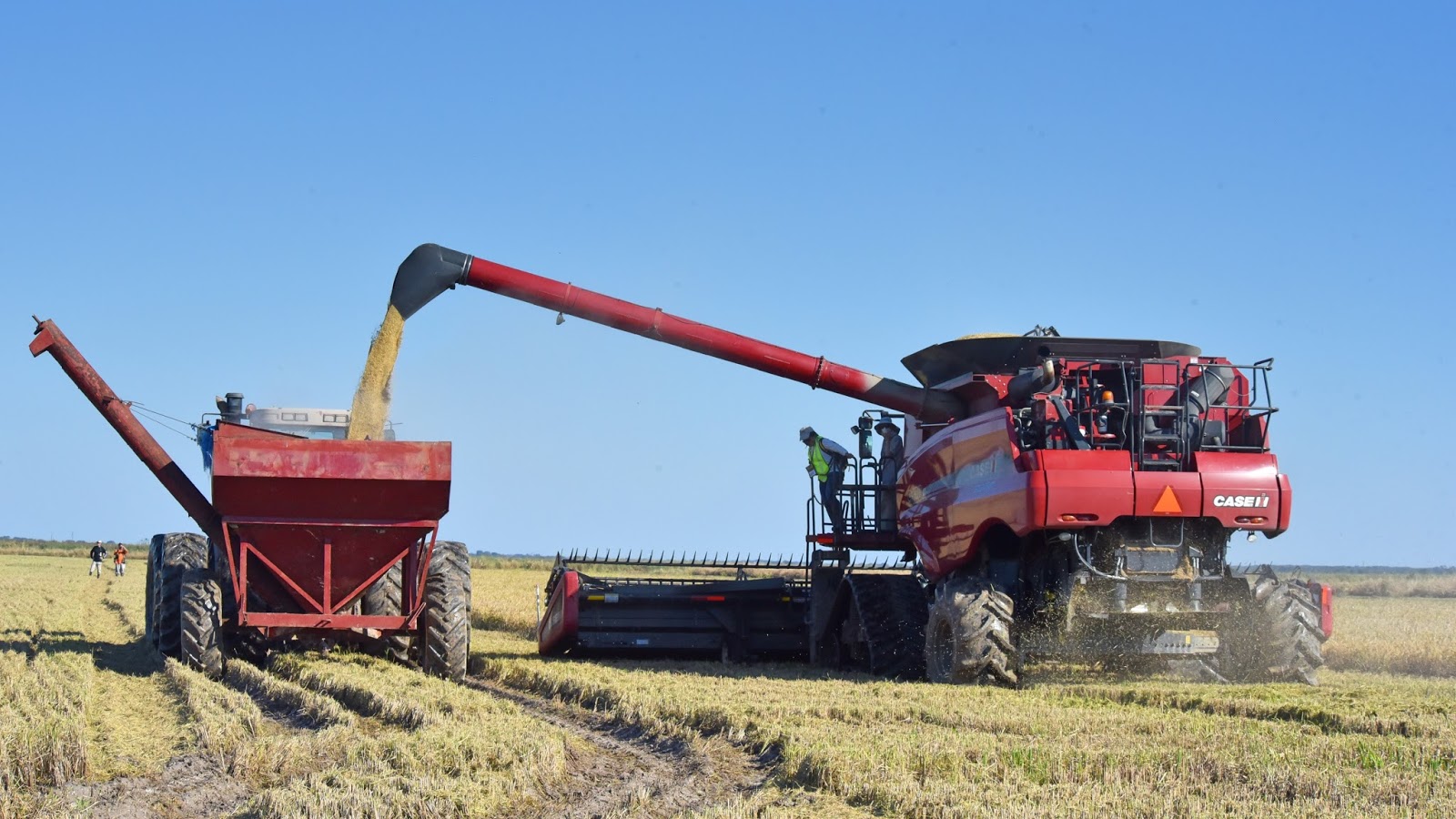

A very cool aspect of this event is that attendees get to ride on the combine! We were able to take two laps around the field, getting a monster's eye view of the whole process. Here's a view of how the machine works from the platform where the driver sits:


Otherwise, visitors are encouraged to walk through the (muddy) field to get close to the action, and the organizers had ATVs with which they gave rides alongside the combine.


From a birding perspective, we had many great looks at Yellow Rails, although it was tough to see the birds because they are small and understandably) were moving VERY quickly away from the huge beast:

Yellow Rail is in front of the third person from the right. Looks like only one person in that group is seeing this bird!

Zoom in to Yellow Rail
 Another view of a Yellow Rail:


We even had a few King Rails, a large fresh-water wading bird similar to Clapper/Ridgeway's Rail that's typically found along the Gulf Coast.


Mammals may take refuge in the fields, too, and they also run for new cover when the combine approaches.

This young raccoon didn't look very happy, both because of the impending machine and because we likely saw its parent on the other side of the field, headed the opposite direction.

While the mosquitos and related biting insects were surprisingly not bad at all, there was one slightly creepy element of the day: flying spiders!
The white lines you see are spider webs caught on electrical wire. Throughout the day, tiny spiders on the end of long strands of web (up to several feet long) were drifting through the skies and landing in the fields. Although, we never did actually see one running around on us, presumably they landed on us, too! Yikes!

The day ended with some really awesome jambalaya, sweet dough pies, cold beer, a local trio of musicians, and an amazing sunset. This was a really fun festival, and worth attending if you'd like to see some interesting birds and experience a unique part of the country!

Me

Thursday, October 29, 2015

Laissez les bonnes oiseaux rouler!

Bonsoir from Louisiana!

My Ghost Blogger has been absent/lazy for a few days, so I apologize for the absence of posts. She has been fired for dereliction of duty, and a new Ghost Blogger will be hired soon. In the meantime, you're stuck with me.

I'm sure you've been wondering what has transpired since the last post. "What amazing adventures have they embarked upon, only to keep secret from their devoted followers?" is a question I'm sure you've asked yourself nightly. "Did they quit early and not tell anybody?" would be reasonable. "Do they not love us any more?" is undoubtedly also at the top of your mind.

To address these burning questions: Very Little, Definitely Not, and We Absolutely Still Do.

So, what has happened?

Mostly, the past several days have been about work and life. On the birding front, our only recent expedition was over to Marin, in search of two rare vagrants: a White Wagtail, an Arctic bird that we missed in Nome but that somehow ended up in Northern California, and an even more rare Dusky Warbler, which is common in Asia but has only been reported a handful of times EVER in NorCal. We struck out on the warbler, but did manage to find the Wagtail, for bird #671 for the year.

Candidate for "Crappiest Picture Ever". Blame Ms. Wagtail for not flying to our side of the lake.
The wagtail happened also to be The Wife's 700th Life Bird, so congratulate her on joining the 700 Club when next you see her!

Now, though, things are about to get interesting. We are in Cajun Country for a few days of jambalaya, gumbo, and boudin, and also for an interesting sounding festival called, "Yellow Rails and Rice". This festival takes advantage of how rice harvesting disturbs birds that are hiding in the wet rice to show attendees all kinds of rails, including the enigmatic Yellow Rail.

After that, we're headed to southern Texas (AGAIN) for a boat trip (AGAIN) and the Rio Grande Valley Birding Festival. Subsequently, we may visit the Most Boring City in America (Lubbock, TX) for a late attempt at Lesser Prairie Chicken, and then Denver for one more shot at Boreal Owl. Or, we may reschedule everything depending on the weather and our whims. That would be just like us.

Stay tuned!
Me (Not the fired Ghost Blogger, for reals)

Tuesday, October 20, 2015

Preparation + Opportunity = Luck

Usted hace su propia suerte,

As Tina Turner sang, "What's Luck Got To Do With It?" At least, I think it was Tina. It could have been the coach of the Indianapolis Colts, responding to a question about why they lost last week. Or something like that.

In our case, it all depends on how you define luck.

This weekend saw us pick off four new birds, bringing our total to 670 for the year. All of these finds could be considered "lucky", in that they didn't just fly up and land on our heads. For instance:

  • After driving around farmlands outside of Bozeman, MT, for three hours trying to find Gray Partridge, we decided to make one last stop before lunch at some fields where they had been reported over the summer. These fields were in town, across from a large apartment complex, so we parked and walked along the road to avoid clogging up traffic. Suddenly, The Wife shouted, "Over there!" as she happened to briefly see a large group of appropriately-sized birds land about 200 yards away in a nearby pasture. After waiting 15 minutes for them to see them through the thick grass, she may also have hopped over the barbed-wire fence and stomped through the pasture to encourage them to move. But she wouldn't brazenly flaunt birding etiquette to do something like that, so I must be mis-remembering.
  • At the Victoria International Airport in Sidney, British Columbia, we walked three miles around the perimeter of the airport trying to find Sky Lark, frustrated in our efforts to hear them by the din of planes landing, helicopters taking off, lawnmowers munching through grass, and cars passing. But, at one point, there was a lull in the noise, and we heard their distinctive buzzy calls! They were far from the fenceline, hopping in the grass perilously near the runway, so we were never had great looks but we did clearly hear the song.
  • After disembarking from the Sidney-to-Anacortes, WA ferry, we took a side road to a nearby bay to find an Eurasian Wigeon that had been reported the previous day. That bay had exactly zero ducks on it, so we continued along the side road to connect back with the highway. The road was surrounded by trees, but just before reaching the highway, the trees ended and we had another angle on the water. And, lo, and there was a large flock of ducks! Making an abrupt left into the parking lot of a Native-American-run casino, we scanned the flock and found our wigeon.
In all of these cases, the birds we were trying to find were somewhat uncommon and either secretive or very nomadic, or both, and so challenging to locate. And, all of them were found because of some turn of events. But, I don't think these were all merely cases of being "lucky".

We had traveled to those locations because we knew the birds were there, either because they were known to be resident or had been recently reported. We could identify the birds because we had studied their pictures and sounds, so we could pick key field marks out quickly. And, we knew their habits, so we knew where and when to look. As the Roman philosopher Seneca reportedly said, "Luck is what happens when preparation meets opportunity." So with that definition, we were lucky to find those birds. 

Remember that the next time you shoot a basketball from half-court and it goes in, and your buddies say, "Lucky shot, dude!" Just tell them that you were prepared, and that Tina Turner would be proud.