Tuesday, June 16, 2015

72 Hours in Alaska

Greetings from Anchorage, Alaska!

Great White North my ass. This is the Blue-Green North, where the skies are clear and a beautiful deep indigo, the forests are fiercely verdant, and yesterday’s temperature topped out at…


So, I can confirm that if your concept of Alaska evolved from watching too many episodes of Ice Road Truckers or Deadliest Catch, and you think that the entire state is permafrost or constantly battered by horrific storms, then you would be wrong. (But BTW, if you have not seen Ice Road Truckers, then what the heck are you doing with your life?)

On the other hand, if you’ve heard of Alaska as “the land of the midnight sun” then you would be correct. Sunset in Anchorage today occurs at nearly midnight, and here is what the street outside last night’s restaurant looks like at 10:30pm:


But, you ask, what about the birds??? The past three days for us have been a blur or birding and traveling, as 20 hours of daylight means lots of time to look for birds!

We arrived in Anchorage on Thursday evening and birded some of the local area. A common thread of the past few days has been that birdie babies are just now hatching and stretching their wings, such as these Arctic Terns from a park south of Anchorage:


Friday, we drove down to Homer, and along the way encountered our first Moose. If you’ve never seen a moose, you might think of them as large cows or elk. If this sounds right to you, then you are comically mistaken. An adult male moose is about the size of a Mack truck, or so they appear from relatively close distance: from about 100 yards away, we saw a moose run across the road and behind a group of motorcyclists, and I swear that it looked more than twice the height of the cyclists.

Saturday, we boarded the ferry to Kodiak, and proceeded to spend most of the next 23 hours on the ocean, as Kodiak is a 10-hour one-way journey. Why in the world would we do this? Well, we couldn’t find a pelagic birding trip that worked with our schedule, so we decided to take a ferry instead!

An ocean-going trip to look for birds consists of long periods of boredom interspersed with short periods of frustration, as you attempt to identify birds you’ve never seen before while the boat is moving one way and the birds are moving another. Thanks to years of experience combined with the famous Spray-And-Pray photographic technique, we managed to bag several good birds including:


The incomprable Northern Fulmar

The freaky cool Fork-tailed Storm-petrel. How fantabulous is it to have "Storm" be a part of your name!
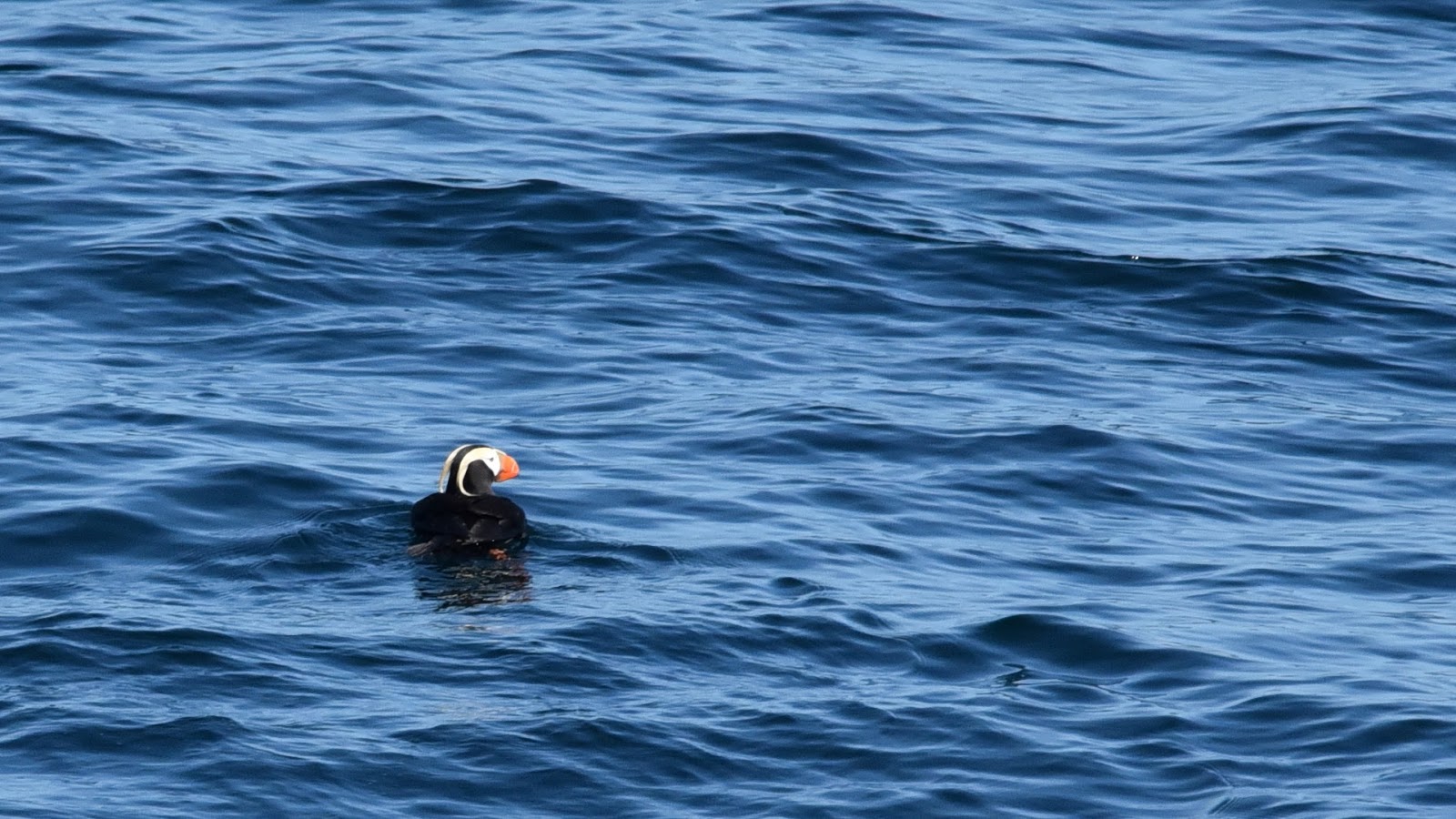
Tufted Puffin, who *just* missed being a spokesmodel for Jheri-curl

While scheduling the ferry on these particular days worked great for our timeline, it also meant that the morning of our wedding anniversary was spent in separate twin bunk beds in a tiny cabin. Fortunately, she is used to such inconveniences and will likely value the Storm-petrels more than any other gift she might have received, so all will be well. One hopes.

Next on the itinerary is Nome, Alaska, the home of the finish line for the Iditarod race and not much else. But, the birds are supposed to be amazing, so wish us luck!

All the best,
Me

Tuesday, June 9, 2015

Packing bags

¡Hola, desconocido!

Well, it's summertime, and the livin' is easy. At least, it has been for the past couple weeks, as we've been getting back into our normal routine, hosting a friend, and taking some time off of birding.

While I was away, it looks like Dr. Sayornis did her usual stellar job of imparting some high-quality education. Thanks, Doc Say, for filling in!

Before I get into the update, I have a favor to ask! Every non-profit could use a little extra cash, and if you use Amazon.com, then they have a very easy way for you to help out your favorite non-profit: Smile! Just go to smile.amazon.com, sign in with your Amazon account, and choose the non-profit you'd like to support. Now, every time you buy something using Smile, Amazon will pay 0.5% of the purchase to that organization! We would appreciate you choosing "Napa-Solano Audubon" as your non-profit, but any group will do. Thanks!

Now, it's time for vacation to end, and for us to get back into the birding groove. Later this week, we depart for a 11-day trip to Alaska, where we'll visit Anchorage, Kodiak Island (briefly), Nome, and Denali National Park. We're only 41 birds from our year goal, and we have a small chance of hitting that mark during this trip!

Meanwhile, we sharpened our skills with a little excursion to the Central Valley, including Rush Ranch for our first-of-year Barn Owls (can you believe we went this long without a Barn Owl?) and the outskirts of Davis for California's own Yellow-billed Magpie.

Pics or it didn't happen? Here you go...

The few, the proud, the Tri-colored Blackbird

Late spring is when fledglings start spreading their wings, but this little Loggerhead Shrike isn't quite sure he digs the flying.

Rush Ranch has a huge barn, and big thanks to the staff member who unlocked the doors so we could get a good look at the resident Barn Owls!

Stop doing that, Owl #2, you're freaking me out.

A cow, some birds, what else could they be than Brown-headed Cowbirds! If you really want to feel bad for the cow, zoom in on the picture so you can see just how many flies she has.
Now, back to filling up those suitcases!

Adios,
Me

Monday, June 8, 2015

Bird Finding 201, Class #3: The Importance of Paying Attention!

Students, attention! Stop messing with your phones! Dr. Sayornis is in da house!

Well, my disciples, we have journeyed long and hard to reach this crossroads in our learning. This is our final lecture, and after today, I will continue onward to more great Bird Finding feats, while you will do...something. Whatever it is that you do. I'm sure it's fine. I don't judge.

In our recent lectures, I have sown several seeds in the fertile soil of your minds, digging into the importance of Time and of Place in Bird Finding. Today, I will dump a big steamy load of high-nutrient compost on these seeds, as you will learn the secret to transforming from a plebeian-grade bird finder into a Ninja Bird Finder Extraordinaire. Because, scientia ipsa potentia est.

Here's the secret: Pay Attention!

But wait, you say, quid est hoc? Actually, that's what *I* would say, as you students wouldn't know the Mother Tongue si momordit vos in nasi. Kids today! When I was a young scholar, school was for learning! Not socializing or playing the foot ball or whatever it is that goes on in "school" today! And if you didn't learn, the good Sister had a ruler that would beat Knowledge into you! But, I digress; mox nox in rem.

Now, the road to finding a bird is paved with feathers from the birds that you missed, so it's thick and fluffy and a little hard to walk upon. But, birds leave clues to their location and identity like a politician makes promises at election time, so just Pay Attention! and birds will literally jump out of trees at you.

To illustrate, let me regale you with tales of how the good Doc Say did or didn't find his bird due to attention.

In Florida, at Bahia Honda State Park, I was scanning trees for warblers when a cuckoo landed nearby. Having seen cuckoos many times before, I just glanced casually at the bird before walking on. I assumed it was a Yellow-billed Cuckoo, as I had seen these recently, but when I checked online to see how often they had been reported, I was shocked to discover that NONE had been reported. However, the elusive Mangrove Cuckoo, had been reported several times at the park! So did I have the first sighting of a Yellow-billed for the season, or my first ever Mangrove? I hadn't looked closely at the field marks, so I had no idea, and sadly had to eschew reporting it.

In Cave Creek, Arizona, I was strolling through a campground, watching the sky for hawks, when something caught my ear:


Unfamiliar with the sound, I traced it to a small branch high in a tree, only to be blazed by the iridescence of a Blue-throated Hummingbird! Had I not noticed the sound, I never would have seen that bird.

Sometimes, an unusual situation should cause your attention to be raised. Earlier this year, at Estero Llano Grande State Park in Texas, I unexpectedly discovered a large flock, a dozen or so, of Clay-colored Thrush feeding on ripe berries from anacua trees. Previously, I had only seen these one or two at a time, so I should have been more interested in studying them, but instead I walked onward. Just the next day, Rare Bird Alerts were afire with news that a very unusual White-throated Thrush had been seen in those anacua trees! Had I seen it? I don't know, because I wasn't freaking Paying Attention!

The last piece of advice I would have along these lines is semper paratus. You know better than to take your final exam without studying (don't you?!?!), so why would you venture into The Field without knowledge of what you might see? In Arizona, I was hiking a trail through dense mesquite brush, when a small warbler with a solid gray head and yellow chest popped into view. Knowing that these field marks could mean only one of a couple birds, I quickly looked for the definitive mark: indeed, he had a broken white eye ring, which could only mean a MacGillivray's Warbler! So, by knowing the field marks and what birds were likely in the area, a bird could be identified with only a brief glance.

And with that, our Bird Finding 201 class concludes. For your next Bird Finding Expedition, you will know to prepare in advance, go to the right habitats, spend the proper time, and dammit Pay Attention!

Now, go out there and make me proud,

Dr. Sayornis
In vino veritas